An Essential Guide to Parents Evening – 10 Top Tips for Making the Most of It.
Maths and English worksheets for your child's year group, made by Sunita, an experienced UK primary school teacher. Print them at home and sit together for ten minutes.
Free trial, no card
Try the classroom free for 7 days
Sign up free, pick your child's year group and print 3 worksheets this week. Made by a UK primary school teacher, yours to use at the kitchen table.
- ✓Made by an experienced UK primary school teacher
- ✓Mapped to the national curriculum, Reception to Year 6
- ✓Print at home and work on paper, no screen needed
No card needed. One teacher, every worksheet.

What to Expect at Parents Evening
Going to your child’s parents evening can be a daunting experience for some parents – it could be the first time you have been in a primary school since you left school yourself!
Most schools have two parents evenings a year, some have three. You will be given a 5 or 10 minute time slot, this is usually enough time. However, if you have more to ask your child’s teacher, don’t be scared to ask if you can meet again to discuss specific issues.
During the meeting, your child’s teacher will give you an overview of what your child is like at school. If the parents meeting is at the beginning of the academic year, the teacher won’t have had time to get your child and will only be able to tell you about what he/she has seen so far. Towards the end of the academic year, the teacher should know your child a lot better and be able to answer more specific questions and give you a good idea on your child’s progress throughout the year.
The teacher should be able to tell you about all aspects of your child’s development. Social, emotional academic and physical development can be discussed.
What Information Will You Be Given at a Parents Meeting?
Here are some of the things your child’s teacher might talk to you about:
- How your child has settled in class.
- What subjects/topics will be covered throughout the term/year.
- Friendship groups and/or issues that may have come up.
- Homework – if it is being completed and handed in.
- Reading- how to improve on it, or if your child is reading/being read to regularly.
- Spellings – test results.
- Strengths and/or weaknesses in a particular area of the curriculum.
- An overview of progress in Maths and English.
- If your child answers/asks questions during whole class sessions.
- How confident your child is.
- PE – if kit is brought to school regularly.
What to do with the list of Maths and English skills your child's teacher has said your child needs to improve on.
Join Teach My Kids
- Get access to targeted worksheets for you child's year group in Maths and English.
- Use Teach My Kids literacy worksheets and maths worksheets to improve your child's skills and learning at school. Give your kids a helping hand.
Buy Printable Workbooks to Targets Specific Learning Gaps
10 Top Tips for Making the Most of Parents Evenings
Here are some tips on making the most of a meeting with your child’s teacher:
- Don’t be scared to ask questions.
- If you don’t know what a word, phrase or acronym means – ask. Teachers use these everyday and can forget a parent may not have heard of it before, or may not know what it means.
- It’s not all about academic achievement, ask how your child interacts with other children and who their friends are.
- Ask how often children are listened to read at school.
- Find out what your child’s targets are in reading, writing and maths. Make sure your child also knows what they are.
- Find out what level your child is working at in Maths and English. How much progress does the teacher expect your child to make by the end of the year?
- Ask for suggestions on how you can help your child with their targets at home.
- Ask what kind of questions you can ask your child at home to help them with their understanding in a topic or subject.
- Find out if your child has the confidence to ask for help when they don’t understand something?
- Ask if you can have a quick look at child’s Maths or English book.
Join Teach My Kids to gain access to writing worksheets, plus Maths and English Worksheets covering a wide range of topics.



Who makes the worksheets
Sunita
UK primary teacher
Every worksheet on Teach My Kids is made by Sunita, a UK primary school teacher with over ten years in the classroom. She writes each one by hand and maps it to the national curriculum, so what your child practises at home lines up with what they do at school. It's all on paper, not a screen, and takes about ten minutes a day.
Try the classroom freeWhat you're joining
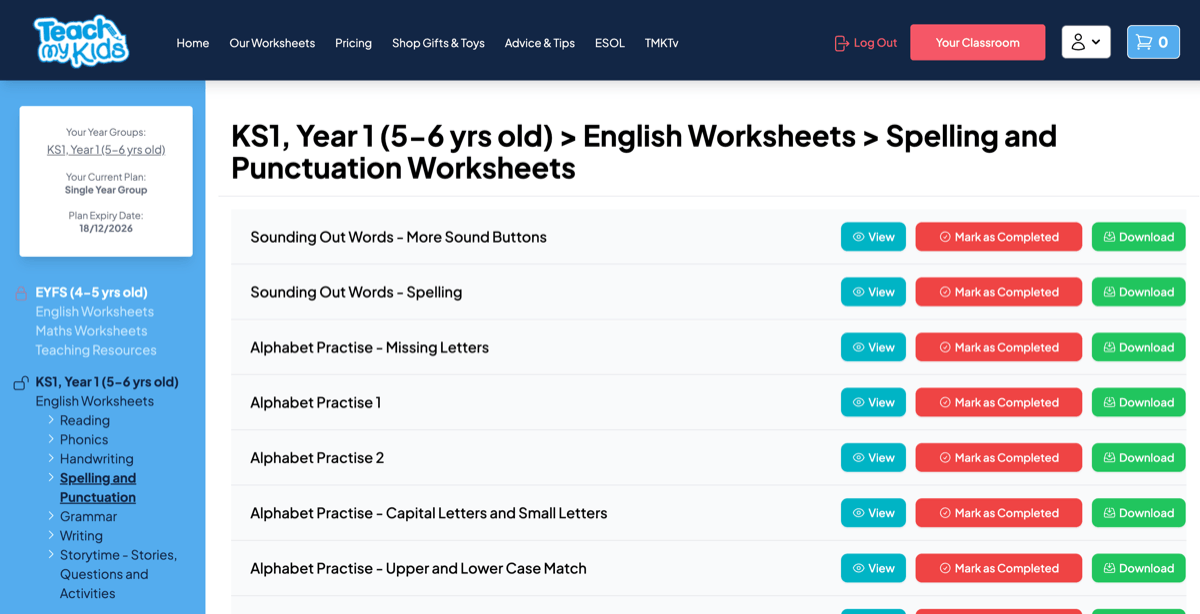
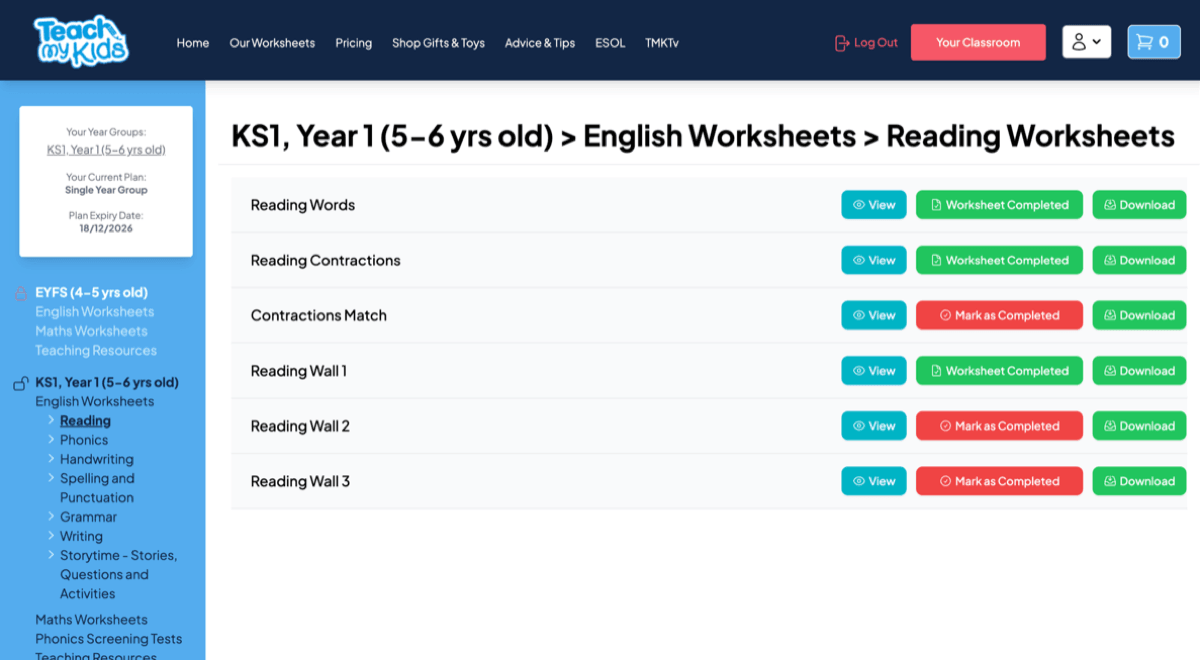
This is your child's online classroom.
You're not buying a single worksheet. You log in to a space set up for your child, where the full library unlocks and everything stays in one place.
-
1.
Your own space, any time.
A login for your family. No app to install. Open it whenever suits you.
-
2.
Set to your child's year.
Pick their year group and the right worksheets unlock. Move it up as they grow.
-
3.
The whole library unlocks.
Every worksheet for their year in maths and English, matched to the school curriculum and sorted by topic. Not one sheet, all of them.
-
4.
Print what you need, when you need it.
The whole library is open, so you print this week's topics when they come up at school. No daily limit and nothing to ration. Come back as often as you like.
-
5.
Tick off what's done.
Mark each worksheet as done so you can see what your child has covered.
Common questions
Questions parents ask
- Are the worksheets made by a teacher?
- Yes. Every worksheet is created by an experienced UK primary school teacher and mapped to the national curriculum, so what your child practises lines up with school.
- How does Teach My Kids work?
- Set your child's year group and the matching maths and English worksheets unlock. Print what you need at home, sit together for ten minutes, then tick off what they have finished.
- Can I print the worksheets at home?
- Yes. They are built for paper, so you print them at home and your child works away from a screen. That is the whole point: structured practice, off the device.
Year groups
Set your child's year and their library unlocks.
Every year is mapped to the UK curriculum. Pick the year your child is in and that whole library opens up. Move it up as they grow, or drop back a year if they need to catch up.
From the kitchen table
From parents who already print at home.
Real parents, phonics through to SATs.

Putting Your Child's Education First


General
Worksheets by year and topic
- Reception maths worksheets
- Year 1 maths worksheets
- Year 2 maths worksheets
- Year 3 maths worksheets
- Year 4 maths worksheets
- Year 5 maths worksheets
- Year 6 maths worksheets
- Year 1 English worksheets
- Year 2 English worksheets
- Year 3 English worksheets
- Year 4 English worksheets
- Year 5 English worksheets
- Year 6 English worksheets
- Times tables worksheets
- Multiplication tables check
- Multiplication worksheets
- Division worksheets
- Fractions worksheets
- Decimals worksheets
- Percentages worksheets
- Place value worksheets
- Addition worksheets
- Subtraction worksheets
- Telling the time worksheets
- Shape worksheets
- Grammar worksheets
- Fronted adverbials
- Adverbs worksheets
- Nouns worksheets
- Verbs worksheets
- Adjectives worksheets
- Spelling worksheets
- Handwriting worksheets
- Phonics worksheets
- Phase 5 phonics
- KS2 SATs papers
- KS1 SATs papers
- Year 6 SATs
- Clauses
- Conjunctions
- Pronouns
- Determiners
- Modal verbs
- Apostrophes
- Punctuation worksheets
- Angles worksheets
- Symmetry worksheets
- Perimeter and area
- Rounding worksheets
- Roman numerals
- Negative numbers
- Money worksheets
- Sound buttons
- Tricky words
- Common exception words
- Browse all worksheets →
All rights reserved © Teach My Kids 2026. Site by BillyMedia, a Craft CMS developer