Colouring - Developing Pencil Control or a Holding Activity?
Maths and English worksheets for your child's year group, made by Sunita, an experienced UK primary school teacher. Print them at home and sit together for ten minutes.
Free trial, no card
Try the classroom free for 7 days
Sign up free, pick your child's year group and print 3 worksheets this week. Made by a UK primary school teacher, yours to use at the kitchen table.
- ✓Made by an experienced UK primary school teacher
- ✓Mapped to the national curriculum, Reception to Year 6
- ✓Print at home and work on paper, no screen needed
No card needed. One teacher, every worksheet.

Developing Pencil Control and Fine Motor Skills
Colouring - some kids love it, some kids hate it, some will colour because they have been told to.
Children start to colour at a very young age, quite often in places you don't want them to!
How Does Pencil Control Develop?
Children will start by grabbing a pen or crayon and make marks. Progression from this can include drawing lines or up-down marks. As they become more confident, circular motions will start to develop. From here onwards they will start to make representations of everyday objects / people and start colouring in pictures. All of these steps help the child develop their fine motor skills and pencil control.
What are Fine Motor Skills and Why Are They Important?
Fine motor skills involve the coordination and control of the small muscles in the hands and fingers. These skills are crucial for performing tasks that require precision and dexterity. When your child engages in activities such as holding a pencil, cutting with scissors, buttoning a shirt, or picking up small objects, they are using their fine motor skills.
Developing these skills is essential for your child's ability to perform various everyday activities with ease, and it lays the groundwork for tasks like writing, drawing, and self-care activities. As a parent, supporting and encouraging your child in activities that promote fine motor skills can contribute to their overall growth and independence.
A love/hate relationship.
At some point, children will either love colouring or will just do it for the sake of doing it. Colouring can take some children into their own world and they will take pride in it. They will line up their colours and try their best to stay in the lines. They will enjoy using different media, such a wax crayons, felt pens, gel pens, colouring pencils etc. Parents of these children will have lots of artwork brought home from nursery or school.
On the other hand, some kids will only colour when they are made to. Grudgingly they will quickly make a few marks to show they have coloured and then go off and do something more interesting. Most of the time the child will use just one colour to complete the work!
Primary School Colouring
Pre-school children need to develop pencil control skills and fine motor skills, colouring is one way of doing this. It can be the pre-cursor to developing writing and encourages creativity. But is this the same when they are at primary school and when they go into KS2?
Do teachers sometimes use colouring as a holding activity, to keep children occupied, maybe because they have finished their work too quickly? I often ask my children what they did at school today. The reply from my youngest would be, ' I did some colouring.' Rarely remembering what she coloured and why!
Could that time have been spent better doing something else? Or working on an extension activity? It's easy to say to a child 'now go and colour it in,' but maybe teachers need to consider what the child is going to gain from it. If it will enhance the work, develop or improve the presentation of the work, then it is worth doing. But if it is just to keep the child occupied, whilst the others finish their work or catch up, then more times needs to spent providing the child with extension activities.
In Need of Maths and English Worksheets?
Join Teach My Kids for targeted Maths and English Worksheets for Primary School Children



Who makes the worksheets
Sunita
UK primary teacher
Every worksheet on Teach My Kids is made by Sunita, a UK primary school teacher with over ten years in the classroom. She writes each one by hand and maps it to the national curriculum, so what your child practises at home lines up with what they do at school. It's all on paper, not a screen, and takes about ten minutes a day.
Try the classroom freeWhat you're joining
This is your child's online classroom.
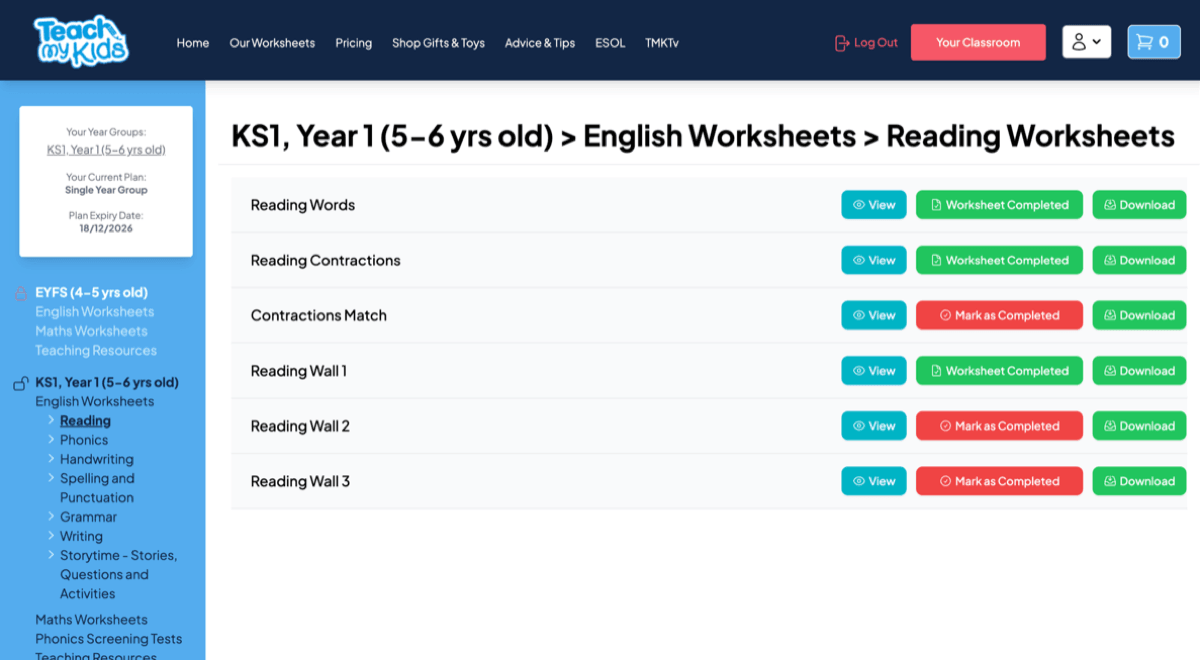
You're not buying a single worksheet. You log in to a space set up for your child, where the full library unlocks and everything stays in one place.
-
1.
Your own space, any time.
A login for your family. No app to install. Open it whenever suits you.
-
2.
Set to your child's year.
Pick their year group and the right worksheets unlock. Move it up as they grow.
-
3.
The whole library unlocks.
Every worksheet for their year in maths and English, matched to the school curriculum and sorted by topic. Not one sheet, all of them.
-
4.
Print what you need, when you need it.
The whole library is open, so you print this week's topics when they come up at school. No daily limit and nothing to ration. Come back as often as you like.
-
5.
Tick off what's done.
Mark each worksheet as done so you can see what your child has covered.
Common questions
Questions parents ask
- Are the worksheets made by a teacher?
- Yes. Every worksheet is created by an experienced UK primary school teacher and mapped to the national curriculum, so what your child practises lines up with school.
- How does Teach My Kids work?
- Set your child's year group and the matching maths and English worksheets unlock. Print what you need at home, sit together for ten minutes, then tick off what they have finished.
- Can I print the worksheets at home?
- Yes. They are built for paper, so you print them at home and your child works away from a screen. That is the whole point: structured practice, off the device.
Year groups
Set your child's year and their library unlocks.
Every year is mapped to the UK curriculum. Pick the year your child is in and that whole library opens up. Move it up as they grow, or drop back a year if they need to catch up.
From the kitchen table
From parents who already print at home.
Real parents, phonics through to SATs.

Putting Your Child's Education First


General
Worksheets by year and topic
- Reception maths worksheets
- Year 1 maths worksheets
- Year 2 maths worksheets
- Year 3 maths worksheets
- Year 4 maths worksheets
- Year 5 maths worksheets
- Year 6 maths worksheets
- Year 1 English worksheets
- Year 2 English worksheets
- Year 3 English worksheets
- Year 4 English worksheets
- Year 5 English worksheets
- Year 6 English worksheets
- Times tables worksheets
- Multiplication tables check
- Multiplication worksheets
- Division worksheets
- Fractions worksheets
- Decimals worksheets
- Percentages worksheets
- Place value worksheets
- Addition worksheets
- Subtraction worksheets
- Telling the time worksheets
- Shape worksheets
- Grammar worksheets
- Fronted adverbials
- Adverbs worksheets
- Nouns worksheets
- Verbs worksheets
- Adjectives worksheets
- Spelling worksheets
- Handwriting worksheets
- Phonics worksheets
- Phase 5 phonics
- KS2 SATs papers
- KS1 SATs papers
- Year 6 SATs
- Clauses
- Conjunctions
- Pronouns
- Determiners
- Modal verbs
- Apostrophes
- Punctuation worksheets
- Angles worksheets
- Symmetry worksheets
- Perimeter and area
- Rounding worksheets
- Roman numerals
- Negative numbers
- Money worksheets
- Sound buttons
- Tricky words
- Common exception words
- Browse all worksheets →
All rights reserved © Teach My Kids 2026. Site by BillyMedia, a Craft CMS developer