Understanding Phonics and CVC Words
Maths and English worksheets for your child's year group, made by Sunita, an experienced UK primary school teacher. Print them at home and sit together for ten minutes.
Free trial, no card
Phonics and early writing for EYFS
Sign up free, pick your child's year group and print 3 worksheets this week. Made by a UK primary school teacher, yours to use at the kitchen table.
- ✓Made by an experienced UK primary school teacher
- ✓Mapped to the national curriculum, Reception to Year 6
- ✓Print at home and work on paper, no screen needed
No card needed. One teacher, every worksheet.
What is Phonics?
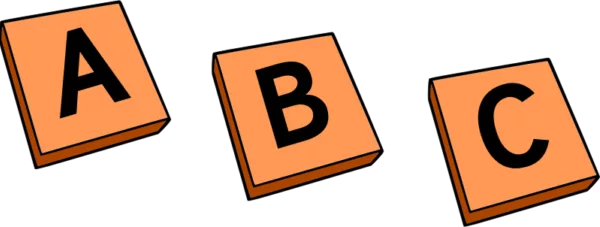
Phonics is taught to all children in the Foundation Stage and KS1. Children learn the letter sounds and use them to help with learning to read and write.
Understanding What Phonics is
Understanding the principles of phonics is essential to supporting a child's early literacy skills. Phonics is a way of teaching children to read and write, it involves associating sounds with symbols for effective decoding.
As parents play an important role in their children's early literacy development, understanding concepts like phonics can greatly increase their ability to support their child's learning journey.
Phonics in the Early Years
Phonics is a method used in teaching children to read and write by associating sounds with symbols, helping them decode words independently. An important aspect of phonics, particularly in the early stages, is the introduction of CVC words.
Phonics revolves around breaking down words into individual sounds, or phonemes, and teaching children the corresponding letters or letter combinations representing these sounds. This systematic approach aids children in understanding the relationship between letters and sounds, laying the foundation for proficient reading and spelling. The starting point in phonics education often involves simple word structures, such as CVC words.
CVC Words
CVC stands for consonant-vowel-consonant, and CVC words are three-letter words comprised of a consonant, a vowel, and another consonant. Examples of CVC words include "cat," "dog," and "sun." Understanding CVC words is crucial for early readers as they form the foundation for more complex word structures.
How Parents Can Help With Phonics
Parents can help with introducing phonics and CVC words to their children through engaging activities.
- Start by emphasising the individual sounds of letters and then blending them together.
For example, when introducing the word "cat," sound out each letter sound (/c/ - /a/ - /t/) and then blend them together to form the complete word. - Use visual aids such as flashcards or interactive games to make learning phonics and CVC words enjoyable.
Encourage your child to listen for the distinct sounds in words and identify the corresponding letters. Reading books that emphasise CVC words can also be an effective way to reinforce these concepts in a real-world context. - Consistency is key in phonics instruction.
Regular practice and exposure to CVC words will help solidify your child's understanding of letter-sound relationships. - Celebrate their achievements and progress, creating a positive learning environment that fosters a love for reading.
Phonics and CVC words play a crucial role in early literacy development. By understanding these concepts and incorporating them into daily activities, parents can help their children to become confident and proficient in reading and writing.
Remember that patience and encouragement go a long way in nurturing your child's literacy skills.
Child Struggling with Phonics?
Join Teach My Kids
Get access to targeted worksheets for you child's year group in Maths and English.
Use Teach My Kids literacy and phonics worksheets to improve your child's reading, writing and spelling. Give your kids a helping hand today.
Free Phonics Worksheet - CVC Words
Teach My Kids, phonics activities: Using the pictures on the worksheet as a prompt, children write the first sound of the cvc word. A cvc word is a three letter word that has a consonant, vowel consonant. Cvc words are easy for children to sound out, read and spell using their phonic knowledge.
Download Your Free Teach My Kids 'CVC Words' Worksheet



Who makes the worksheets
Sunita
UK primary teacher
Every worksheet on Teach My Kids is made by Sunita, a UK primary school teacher with over ten years in the classroom. She writes each one by hand and maps it to the national curriculum, so what your child practises at home lines up with what they do at school. It's all on paper, not a screen, and takes about ten minutes a day.
Try the classroom freeWhat you're joining
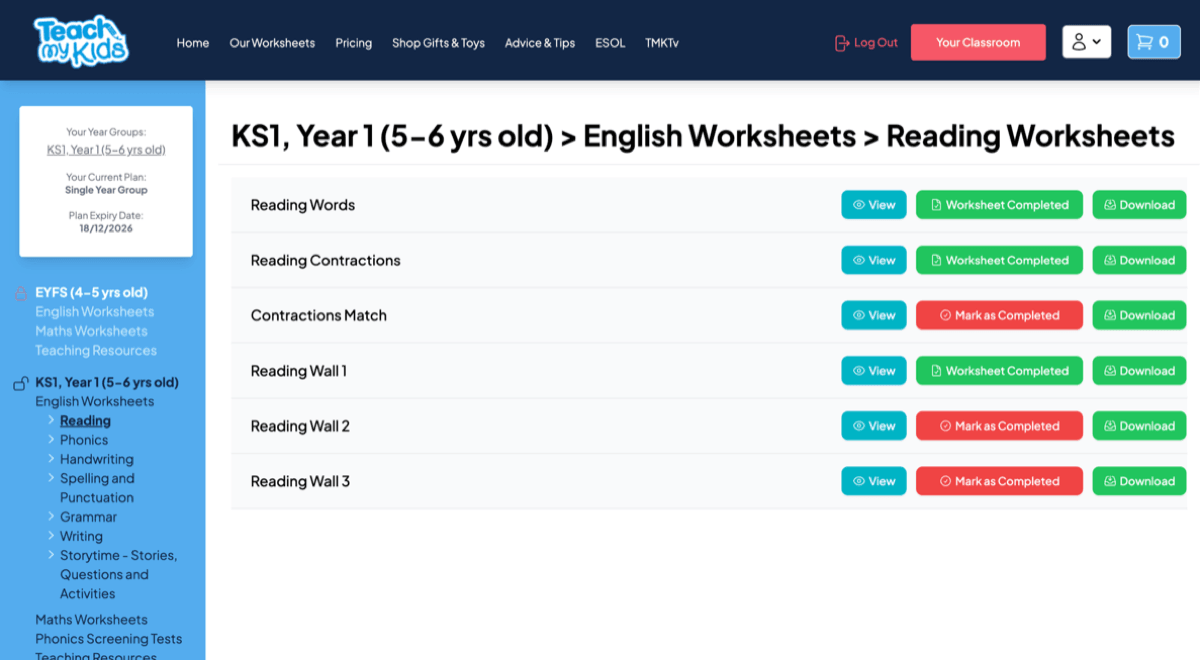
This is your child's online classroom.
You're not buying a single worksheet. You log in to a space set up for your child, where the full EYFS library unlocks and everything stays in one place.
-
1.
Your own space, any time.
A login for your family. No app to install. Open it whenever suits you.
-
2.
Set to your child's year.
Pick their year group and the right worksheets unlock. Move it up as they grow.
-
3.
The whole library unlocks.
Every worksheet for their year in maths and English, matched to the school curriculum and sorted by topic. Not one sheet, all of them.
-
4.
Print what you need, when you need it.
The whole library is open, so you print this week's topics when they come up at school. No daily limit and nothing to ration. Come back as often as you like.
-
5.
Tick off what's done.
Mark each worksheet as done so you can see what your child has covered.
Common questions
Questions parents ask
- Are the worksheets made by a teacher?
- Yes. Every worksheet is created by an experienced UK primary school teacher and mapped to the national curriculum, so what your child practises lines up with school.
- How does Teach My Kids work?
- Set your child's year group and the matching maths and English worksheets unlock. Print what you need at home, sit together for ten minutes, then tick off what they have finished.
- Can I print the worksheets at home?
- Yes. They are built for paper, so you print them at home and your child works away from a screen. That is the whole point: structured practice, off the device.
From the kitchen table
From parents who already print at home.
Real parents, phonics through to SATs.

Putting Your Child's Education First


General
Worksheets by year and topic
- Reception maths worksheets
- Year 1 maths worksheets
- Year 2 maths worksheets
- Year 3 maths worksheets
- Year 4 maths worksheets
- Year 5 maths worksheets
- Year 6 maths worksheets
- Year 1 English worksheets
- Year 2 English worksheets
- Year 3 English worksheets
- Year 4 English worksheets
- Year 5 English worksheets
- Year 6 English worksheets
- Times tables worksheets
- Multiplication tables check
- Multiplication worksheets
- Division worksheets
- Fractions worksheets
- Decimals worksheets
- Percentages worksheets
- Place value worksheets
- Addition worksheets
- Subtraction worksheets
- Telling the time worksheets
- Shape worksheets
- Grammar worksheets
- Fronted adverbials
- Adverbs worksheets
- Nouns worksheets
- Verbs worksheets
- Adjectives worksheets
- Spelling worksheets
- Handwriting worksheets
- Phonics worksheets
- Phase 5 phonics
- KS2 SATs papers
- KS1 SATs papers
- Year 6 SATs
- Clauses
- Conjunctions
- Pronouns
- Determiners
- Modal verbs
- Apostrophes
- Punctuation worksheets
- Angles worksheets
- Symmetry worksheets
- Perimeter and area
- Rounding worksheets
- Roman numerals
- Negative numbers
- Money worksheets
- Sound buttons
- Tricky words
- Common exception words
- Browse all worksheets →
All rights reserved © Teach My Kids 2026. Site by BillyMedia, a Craft CMS developer