Enhancing Children's Learning in Math and English with Flashcards
Maths and English worksheets for your child's year group, made by Sunita, an experienced UK primary school teacher. Print them at home and sit together for ten minutes.
Free trial, no card
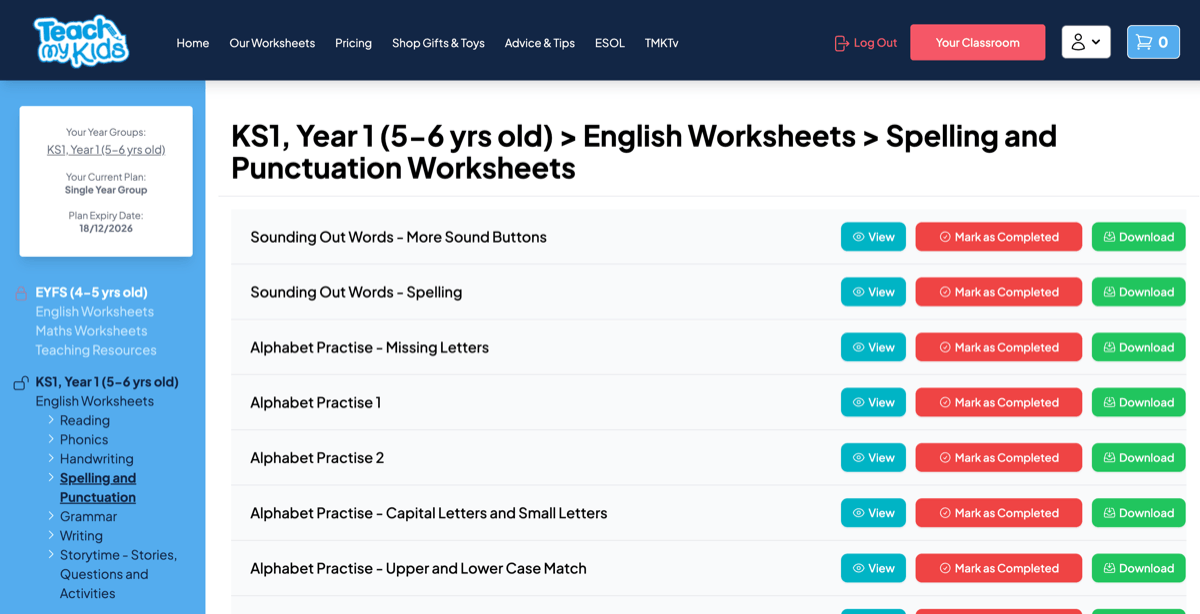
Spelling practice for Year 2, ready to print
Sign up free, pick your child's year group and print 3 worksheets this week. Made by a UK primary school teacher, yours to use at the kitchen table.
- ✓Made by an experienced UK primary school teacher
- ✓Mapped to the national curriculum, Reception to Year 6
- ✓Print at home and work on paper, no screen needed
No card needed. One teacher, every worksheet.
Sometimes that simplest of resources helps children learn effectively and quickly!
Flashcards can help your child learn key facts/information and words. They can be stuck on your child's bedroom wall or on the fridge door. They can be used as a poster or cut up into individual cards. Great for learning maths facts and spellings or key words in english.
These compact cards, containing information on one or both sides, have been a staple in classrooms and homes for decades. They are versatile, aiding learners of all ages and abilities in various subjects. However, when it comes to improving children's proficiency in mathematics and English, flashcards can be particularly useful.
Reinforcing Math Skills
Mathematics can be a daunting subject for many children.
Flashcards offer a tangible solution to this dilemma by breaking down complex mathematical ideas into bite-sized pieces. Addition, subtraction, multiplication, division, fractions, and geometry—no math topic is too intimidating when approached through the lens of flashcards.
- Basic Operations:
Learning basic math operations can be made fun and hands-on with flashcards.
For Example
On one side of the flashcard, there's a math problem like addition, subtraction, multiplication, or division. On the other side, there's the answer. Children can flip through these cards over and over again, practicing the different operations.
By doing this, they get better at solving math problems and understand how these operations work.
- Timed Drills:
To become really quick at math, timed drills with flashcards are a fantastic way to practice.
For Example
Set a timer and challenge kids to solve as many math problems as they can in a certain amount of time. It's like a fun game where they race against the clock.
By doing these timed drills, children can get faster at solving math problems and become more agile thinkers. It's a great way to build their math skills while having fun with flashcards.
- Problem-Solving:
Flashcards aren't just for memorising stuff—they're also useful for boosting problem-solving skills.
For Example
Instead of just equations, create flashcards with word problems or pictures that represent math concepts. This gets children thinking critically and using their analytical skills to solve problems.
By practicing with these kinds of flashcards, kids learn how to think through problems and come up with solutions on their own. It's a great way to make math more engaging and help children become better problem solvers!
Join Teach My Kids and gain access to Maths worksheets specially targeted for your child's year group at school.
Reinforcing Literacy Skills
When it comes to literacy, mastering vocabulary, grammar, and comprehension is important. Flashcards offer a way of practicing and learning these essential skills, making literacy an engaging and interactive experience.
- Vocabulary Building:
Building vocabulary is really important for kids, and flashcards are amazing for this!
For Example
On one side of the flashcard, there's a new word. Then, on the other side, there's the meaning of the word, other words that mean the same thing, or how to use the word in a sentence.
By looking at these flashcards over and over again, kids start to remember the new words. They also learn how to use them correctly. Children can learn lots of new words and become better at using language.
- Grammar:
Learning complicated grammar rules and sentence structures can be tough for kids. But with flashcards, we can make it easier.
For Example
Flashcards can be used for different parts of sentences like nouns, verbs, and adjectives. We can also make cards for punctuation marks like commas and periods.
By using flashcards, kids can see these grammar concepts clearly. It helps them understand and remember how sentences are built and how punctuation works.
- Reading Comprehension:
Reading comprehension is very important for becoming a great reader. Flashcards can really help with this.
For Example
On one side of the flashcard, there's a short passage or a sentence to read. Then, on the other side, there are questions about what was read. When kids read the passage and answer the questions, they're practicing their comprehension skills.
These skills include things like understanding what the text is about, making guesses about what might happen next, and summarising the main ideas. Children can get better at understanding and remembering what they read.
Join Teach My Kids and gain access to English worksheets specially targeted for your child's year group at school.
Maximising the Effectiveness of Flashcards
Flashcards are super useful for learning, but how you use them matters a lot. Here are some tips to make the most of them:
- Be Consistent: Practice with flashcards regularly to reinforce what you're learning.
- Make Them Personal: Customise your flashcards with things that interest you or stuff you need to work on more.
- Have Fun: Turn flashcard practice into games or activities to make learning more enjoyable and memorable.
Following these tips will help you get the most out of your flashcards and make learning even more effective!
Free Teaching Resource and Free Worksheet
How To Use Flashcards.
Make your own flashcards by writing your child's key words or spellings on a blank template.
Cut up the worksheet into individual cards. Hold each card up one at a time and ask your child to say what they see. If they don't know it, you can tell them what it is. Regular practice will help your child learn and remember the information on the flashcards.
Download Your Free Flashcards Template Worksheet



Who makes the worksheets
Sunita
UK primary teacher
Every worksheet on Teach My Kids is made by Sunita, a UK primary school teacher with over ten years in the classroom. She writes each one by hand and maps it to the national curriculum, so what your child practises at home lines up with what they do at school. It's all on paper, not a screen, and takes about ten minutes a day.
Try the classroom freeWhat you're joining
This is your child's online classroom.
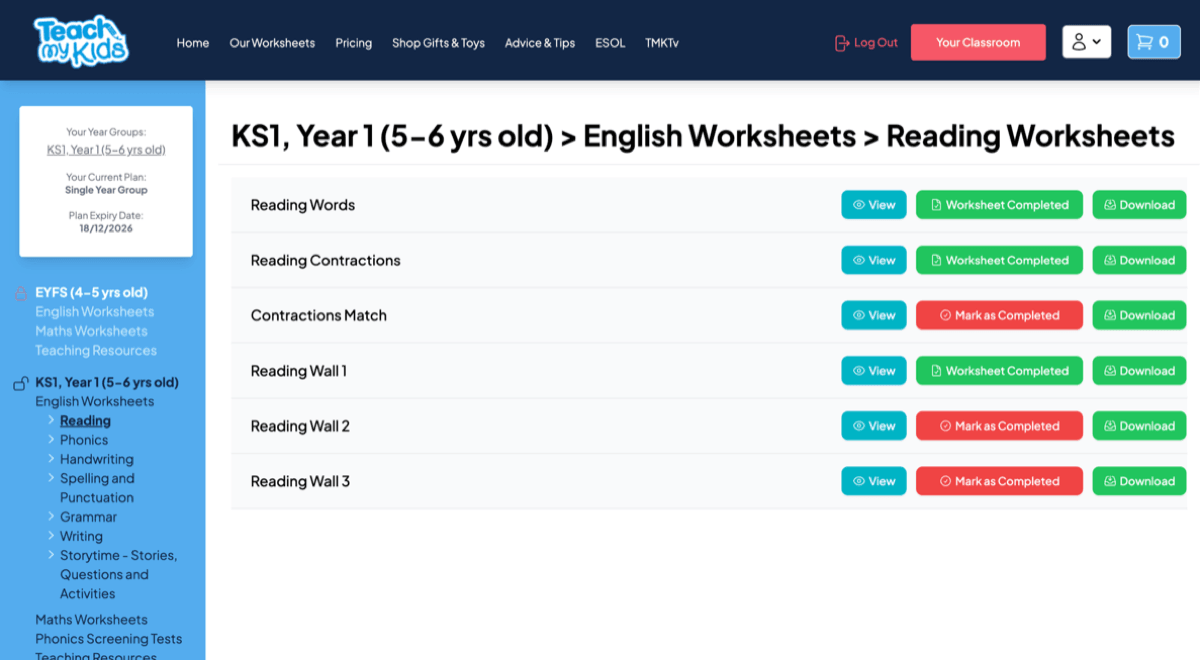
You're not buying a single worksheet. You log in to a space set up for your child, where the full Year 2 library unlocks and everything stays in one place.
-
1.
Your own space, any time.
A login for your family. No app to install. Open it whenever suits you.
-
2.
Set to your child's year.
Pick their year group and the right worksheets unlock. Move it up as they grow.
-
3.
The whole library unlocks.
Every worksheet for their year in maths and English, matched to the school curriculum and sorted by topic. Not one sheet, all of them.
-
4.
Print what you need, when you need it.
The whole library is open, so you print this week's topics when they come up at school. No daily limit and nothing to ration. Come back as often as you like.
-
5.
Tick off what's done.
Mark each worksheet as done so you can see what your child has covered.
Common questions
Questions parents ask
- How can I help my child with spelling at home?
- Keep it short and regular. Five or ten minutes a day beats one long session a week. Pick a few words your child finds tricky, practise them with look, say, cover, write, check, then come back to them later in the week.
- Why does my child struggle with spelling?
- Spelling asks a child to juggle sound, pattern and memory at once, so it often lags behind reading. Most get there with regular practice and a bit of patience. Look at the patterns behind the words, not just the words on their own.
- What is the best way to learn spellings?
- Little and often, tied to words your child already knows. Look, say, cover, write, check works well, and so does spotting the same pattern in other words. Reading together helps too, because it puts the spellings in real sentences.
From the kitchen table
From parents who already print at home.
Real parents, phonics through to SATs.
Putting Your Child's Education First


General
Worksheets by year and topic
- Reception maths worksheets
- Year 1 maths worksheets
- Year 2 maths worksheets
- Year 3 maths worksheets
- Year 4 maths worksheets
- Year 5 maths worksheets
- Year 6 maths worksheets
- Year 1 English worksheets
- Year 2 English worksheets
- Year 3 English worksheets
- Year 4 English worksheets
- Year 5 English worksheets
- Year 6 English worksheets
- Times tables worksheets
- Multiplication tables check
- Multiplication worksheets
- Division worksheets
- Fractions worksheets
- Decimals worksheets
- Percentages worksheets
- Place value worksheets
- Addition worksheets
- Subtraction worksheets
- Telling the time worksheets
- Shape worksheets
- Grammar worksheets
- Fronted adverbials
- Adverbs worksheets
- Nouns worksheets
- Verbs worksheets
- Adjectives worksheets
- Spelling worksheets
- Handwriting worksheets
- Phonics worksheets
- Phase 5 phonics
- KS2 SATs papers
- KS1 SATs papers
- Year 6 SATs
- Clauses
- Conjunctions
- Pronouns
- Determiners
- Modal verbs
- Apostrophes
- Punctuation worksheets
- Angles worksheets
- Symmetry worksheets
- Perimeter and area
- Rounding worksheets
- Roman numerals
- Negative numbers
- Money worksheets
- Sound buttons
- Tricky words
- Common exception words
- Browse all worksheets →
All rights reserved © Teach My Kids 2026. Site by BillyMedia, a Craft CMS developer