How to teach letters and sounds (Phonics) at home
Maths and English worksheets for your child's year group, made by Sunita, an experienced UK primary school teacher. Print them at home and sit together for ten minutes.
Free trial, no card
Phonics and early writing for EYFS
Sign up free, pick your child's year group and print 3 worksheets this week. Made by a UK primary school teacher, yours to use at the kitchen table.
- ✓Made by an experienced UK primary school teacher
- ✓Mapped to the national curriculum, Reception to Year 6
- ✓Print at home and work on paper, no screen needed
No card needed. One teacher, every worksheet.
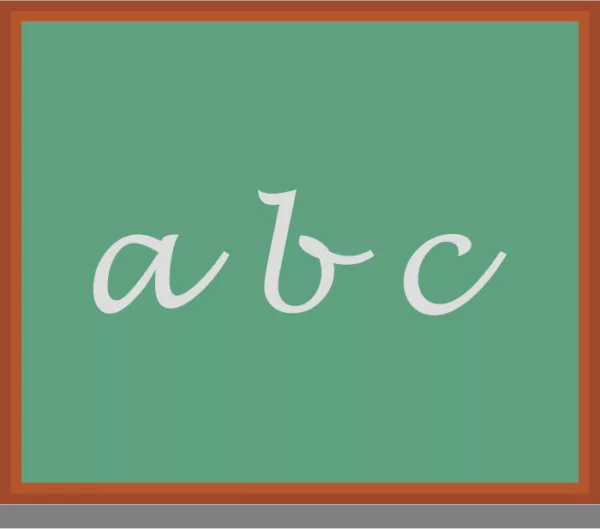
If your child has just started school or is due to start soon, you may want to give them a headstart by helping them learn their letter sounds (phonics).
The way letters and sounds are taught in school is very different to going through the alphabet from a-z.
What is Phonics?
Phonics is a way of teaching kids how to read and say words. It helps them learn the sounds that letters and letter combinations make. With phonics, children connect the spoken sounds of words to the written letters, making it easier for them to read and spell. It's like a fun puzzle that helps kids understand how letters and sounds work together in reading and writing.
How is Phonics Taught in Primary School?
Phonics is taught by helping children learn the sounds that letters and groups of letters make. The focus is on connecting these sounds to reading and writing. Teachers use games, activities, and books that emphasise these letter-sound relationships.
Children in school follow the Letters and Sounds phonics programmes. Teachers provide daily speaking and listening activities at school everyday. The children are split into groups according to their ability and knowledge of phonics.
The Letters and Sounds programme is split into 6 Phases. Each phase aims to develop speaking and listening skills, and prepares children to become fluent readers by the age of 7 by developing their phonic knowledge and skills in a systematic way.
Children start by experiencing a wealth of listening activities including songs, stories and rhymes. They can be divided into seven aspects, including environmental sounds, instrumental sounds, body sounds, rhythm and rhyme, alliteration, voice sounds, oral blending and segmenting.
Join Teach My Kids and download Letters and Sounds activities, worksheets and booklets
Letters and Sounds Phonics Explained
The Letters and Sounds phonics program is a widely used approach in primary schools in the UK to teach children how to read and spell. The program is divided into different phases, each building on the previous one. Here's a general overview:
- Phase 1 (Reception): This phase focuses on developing children's listening skills, sound discrimination, and oral blending and segmenting. It involves activities like playing with sounds, rhyming games, and identifying initial sounds in words.
- Phase 2 (Reception): This phase introduces the first set of phonemes (sounds) and their corresponding graphemes (letters or letter combinations). Children learn to blend sounds to read simple words and segment words into sounds for spelling. Common high-frequency words are also introduced.
- Phase 3 (Reception): More phonemes and graphemes are introduced, including digraphs (two letters making one sound) and trigraphs (three letters making one sound). Children continue to practice blending and segmenting and learn more high-frequency words.
- Phase 4 (end of Reception/beginning of Year 1): This phase focuses on consolidating children's knowledge and fluency in blending and segmenting. It involves reading and spelling more complex words and sentences.
- Phase 5 (Year 1): This phase introduces alternative spellings for the sounds children have already learned. It includes more complex graphemes and additional high-frequency words. The goal is to develop more advanced reading and spelling skills.
- Phase 6 (Year 2 and beyond): This phase focuses on further developing spelling rules, prefixes, suffixes, and understanding more complex word structures. It aims to make children confident and accurate readers and spellers.
Teachers use a variety of resources, including books, games, and interactive activities, to engage children in learning phonics. The approach is often systematic, and regular assessments, including the Phonics Screening Check in Year 1, help identify and support children who may need extra help. The ultimate aim is to equip children with the skills they need to become fluent and confident readers.
Join Teach My Kids and download Letters and Sounds, Phonics activities, worksheets and booklets



Who makes the worksheets
Sunita
UK primary teacher
Every worksheet on Teach My Kids is made by Sunita, a UK primary school teacher with over ten years in the classroom. She writes each one by hand and maps it to the national curriculum, so what your child practises at home lines up with what they do at school. It's all on paper, not a screen, and takes about ten minutes a day.
Try the classroom freeWhat you're joining
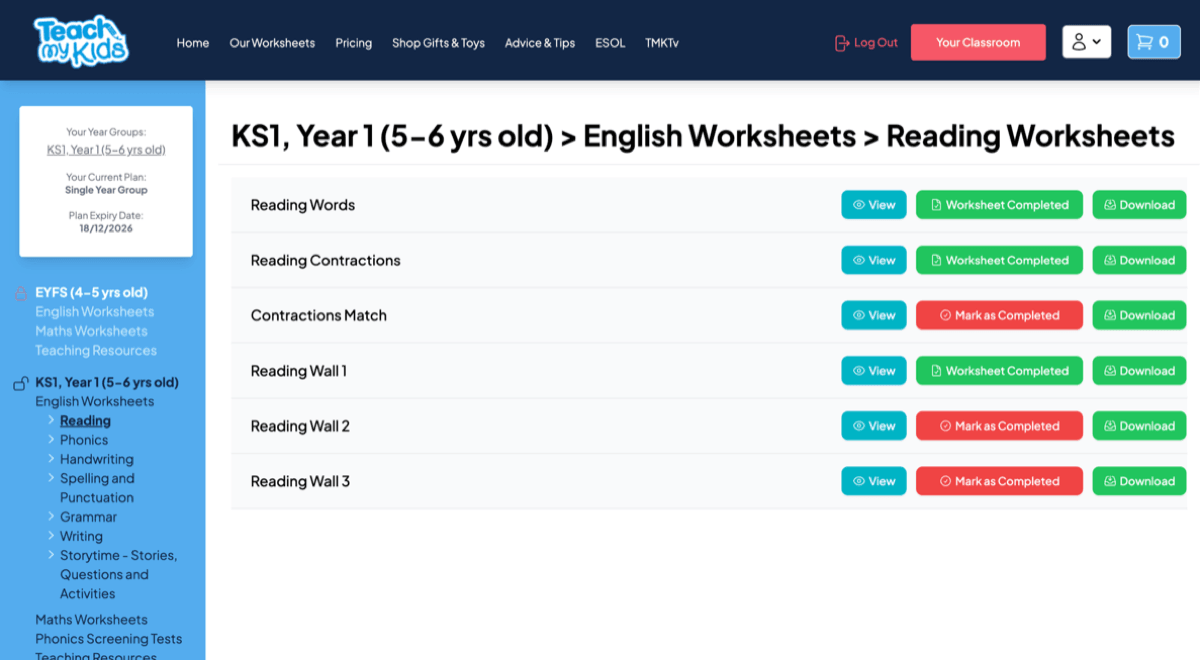
This is your child's online classroom.
You're not buying a single worksheet. You log in to a space set up for your child, where the full EYFS library unlocks and everything stays in one place.
-
1.
Your own space, any time.
A login for your family. No app to install. Open it whenever suits you.
-
2.
Set to your child's year.
Pick their year group and the right worksheets unlock. Move it up as they grow.
-
3.
The whole library unlocks.
Every worksheet for their year in maths and English, matched to the school curriculum and sorted by topic. Not one sheet, all of them.
-
4.
Print what you need, when you need it.
The whole library is open, so you print this week's topics when they come up at school. No daily limit and nothing to ration. Come back as often as you like.
-
5.
Tick off what's done.
Mark each worksheet as done so you can see what your child has covered.
Common questions
Questions parents ask
- Are the worksheets made by a teacher?
- Yes. Every worksheet is created by an experienced UK primary school teacher and mapped to the national curriculum, so what your child practises lines up with school.
- How does Teach My Kids work?
- Set your child's year group and the matching maths and English worksheets unlock. Print what you need at home, sit together for ten minutes, then tick off what they have finished.
- Can I print the worksheets at home?
- Yes. They are built for paper, so you print them at home and your child works away from a screen. That is the whole point: structured practice, off the device.
From the kitchen table
From parents who already print at home.
Real parents, phonics through to SATs.

Putting Your Child's Education First


General
Worksheets by year and topic
- Reception maths worksheets
- Year 1 maths worksheets
- Year 2 maths worksheets
- Year 3 maths worksheets
- Year 4 maths worksheets
- Year 5 maths worksheets
- Year 6 maths worksheets
- Year 1 English worksheets
- Year 2 English worksheets
- Year 3 English worksheets
- Year 4 English worksheets
- Year 5 English worksheets
- Year 6 English worksheets
- Times tables worksheets
- Multiplication tables check
- Multiplication worksheets
- Division worksheets
- Fractions worksheets
- Decimals worksheets
- Percentages worksheets
- Place value worksheets
- Addition worksheets
- Subtraction worksheets
- Telling the time worksheets
- Shape worksheets
- Grammar worksheets
- Fronted adverbials
- Adverbs worksheets
- Nouns worksheets
- Verbs worksheets
- Adjectives worksheets
- Spelling worksheets
- Handwriting worksheets
- Phonics worksheets
- Phase 5 phonics
- KS2 SATs papers
- KS1 SATs papers
- Year 6 SATs
- Clauses
- Conjunctions
- Pronouns
- Determiners
- Modal verbs
- Apostrophes
- Punctuation worksheets
- Angles worksheets
- Symmetry worksheets
- Perimeter and area
- Rounding worksheets
- Roman numerals
- Negative numbers
- Money worksheets
- Sound buttons
- Tricky words
- Common exception words
- Browse all worksheets →
All rights reserved © Teach My Kids 2026. Site by BillyMedia, a Craft CMS developer