KS2 SATs Changes - A guide for parents.
Maths and English worksheets for your child's year group, made by Sunita, an experienced UK primary school teacher. Print them at home and sit together for ten minutes.
Free trial, no card
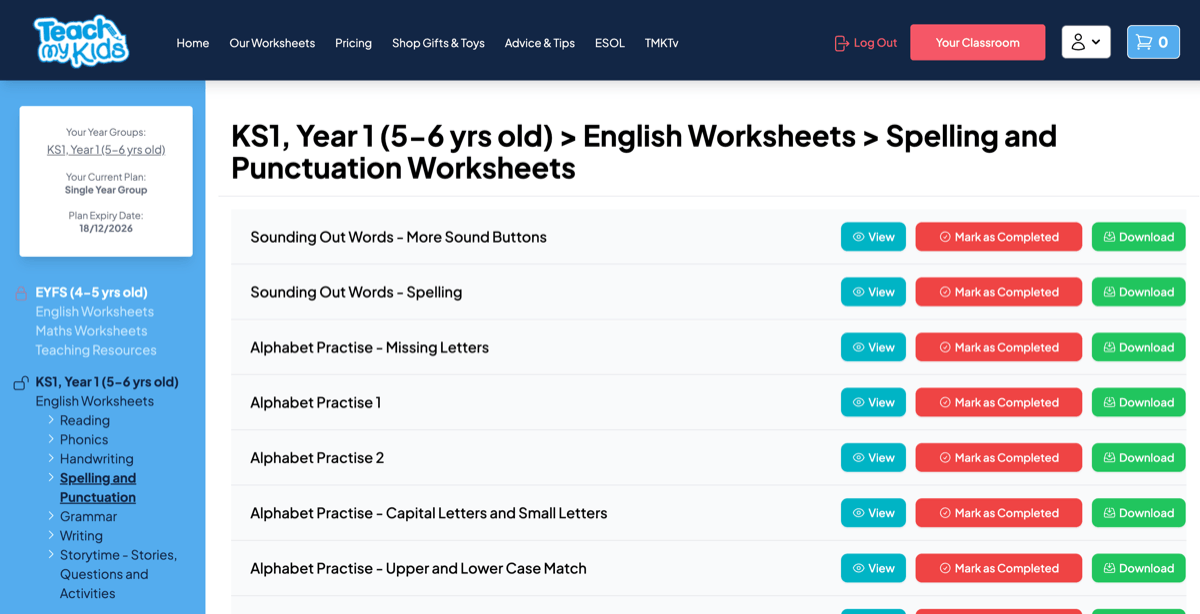
Every Year 6 SATs topic, on paper
Sign up free, pick your child's year group and print 3 worksheets this week. Made by a UK primary school teacher, yours to use at the kitchen table.
- ✓Made by an experienced UK primary school teacher
- ✓Mapped to the national curriculum, Reception to Year 6
- ✓Print at home and work on paper, no screen needed
No card needed. One teacher, every worksheet.

Key Stage 2 SATs 2013 are changing for Year 6 children in Primary School. The maths tests will remain the same, however the English SAT's tests will change so that there is a focus on Grammar, punctuation and spelling. This has been done so that children leaving Primary School are more confident in these areas.
There will not be an extra test in English, but the way children are assessed will change. Children will be tested on Grammar, punctuation and spelling. Writing will be assessed using the teachers knowledge and judgement about your child's writing. Teacher assessment will be used to assess writing composition (composing stories, letters etc)
Overview of Key Stage 2 SAT's:
KS2 English SAT's: Reading Test
Grammar, Punctuation and Spelling (new for 2013)
KS2 Maths SAT's: Mental Maths Test
Maths Paper A
Maths Paper B (calculator allowed)
When will the tests take place?
The SAT's tests, for year 6 children in Primary School, will take place at the beginning of May. SAT's week will begin with the reading test, followed by the new Grammar, Punctuation and Spelling test on Tuesday. The maths tests will then taken on Wednesday and Thursday, starting with the Mental Maths Test.
What is in the Key Stage 2 SAT's Test?
KS2 Reading (1 Hour)
For the SATs Reading Test, children will be given a reading booklet and an answer booklet. Children are given 15 minutes to read the booklet, followed by 45 minutes to answer the questions. There are two types of questions - short, closed questions (multiple choice, short answers) and longer, open-ended questions (requiring children to explain, give reasons or comment on the text to show their understanding)
KS2 Grammar, Punctuation and Spelling (1 hour)
This test is split into two components:
- Grammar, punctuation and vocabulary
- Spelling
Grammar, punctuation and vocabulary (45 minutes)
Children will be given a question booklet to write their answers in. They will need to circle, tick, line or write a short answer. Some questions will ask the child to write a full sentence. The questions start off easy and move onto more difficult questions towards the end of the booklet. The questions will test children's understanding of grammar, punctuation and vocabulary, and their ability to use them in the right way.
Spelling (15 minutes)
Children will be given a booklet to write their answers in. The teacher will read out 20 short sentences, the children will fill in the missing gaps with the word read out by the teacher.
KS2 Mental Maths (20 minutes)
Children will be given an answer sheet to write their answers on. The children will be played a tape with the questions on. After each question has been read out twice, the children will be given a limited time to work out and write the answer before the next question is read out.
KS2 Maths Paper A (45 minutes)
Children will be given a question booklet. The questions will cover all of the areas of maths taught in Primary School, including place value, the four operations, area, symmetry etc. Some of the questions encourage children to show their working out.
KS2 Maths Paper B (45 minutes)
Children will be given a question booklet, but will be allowed to use a calculator to work out their answers.
Find out more about the KS2 Grammer, Punctuation and Spelling Test.
What is the English grammar, punctuation and spelling test?
Why does my child have to take this test?
How will my child benefit from the test?
Is this an extra test?
When will I know how well my child has performed in the test?
Where can I find more information about the test?
Click Here to download a PDF answering your KS2 English SATs questions.


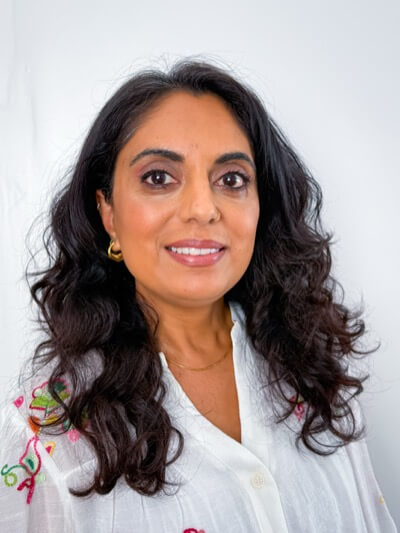
Who makes the worksheets
Sunita
UK primary teacher
Every worksheet on Teach My Kids is made by Sunita, a UK primary school teacher with over ten years in the classroom. She writes each one by hand and maps it to the national curriculum, so what your child practises at home lines up with what they do at school. It's all on paper, not a screen, and takes about ten minutes a day.
Try the classroom freeWhat you're joining
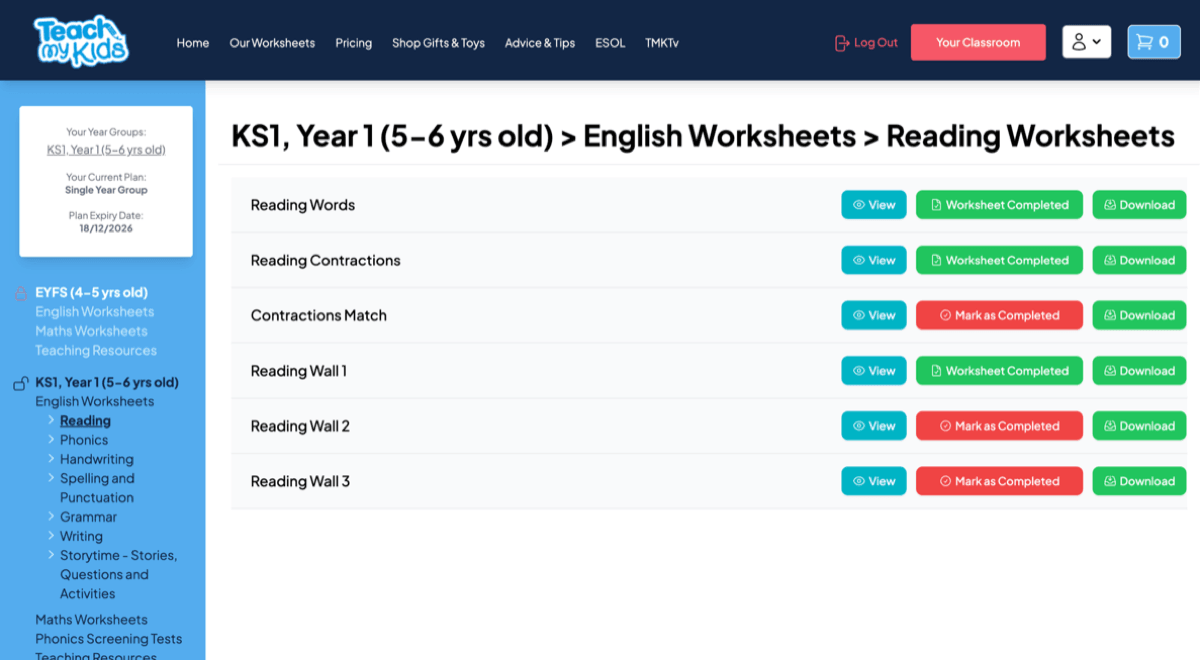
This is your child's online classroom.
You're not buying a single worksheet. You log in to a space set up for your child, where the full Year 6 library unlocks and everything stays in one place.
-
1.
Your own space, any time.
A login for your family. No app to install. Open it whenever suits you.
-
2.
Set to your child's year.
Pick their year group and the right worksheets unlock. Move it up as they grow.
-
3.
The whole library unlocks.
Every worksheet for their year in maths and English, matched to the school curriculum and sorted by topic. Not one sheet, all of them.
-
4.
Print what you need, when you need it.
The whole library is open, so you print this week's topics when they come up at school. No daily limit and nothing to ration. Come back as often as you like.
-
5.
Tick off what's done.
Mark each worksheet as done so you can see what your child has covered.
Common questions
Questions parents ask
- Are the worksheets made by a teacher?
- Yes. Every worksheet is created by an experienced UK primary school teacher and mapped to the national curriculum, so what your child practises lines up with school.
- How does Teach My Kids work?
- Set your child's year group and the matching maths and English worksheets unlock. Print what you need at home, sit together for ten minutes, then tick off what they have finished.
- Can I print the worksheets at home?
- Yes. They are built for paper, so you print them at home and your child works away from a screen. That is the whole point: structured practice, off the device.
From the kitchen table
From parents who already print at home.
Real parents, phonics through to SATs.

Putting Your Child's Education First


General
Worksheets by year and topic
- Reception maths worksheets
- Year 1 maths worksheets
- Year 2 maths worksheets
- Year 3 maths worksheets
- Year 4 maths worksheets
- Year 5 maths worksheets
- Year 6 maths worksheets
- Year 1 English worksheets
- Year 2 English worksheets
- Year 3 English worksheets
- Year 4 English worksheets
- Year 5 English worksheets
- Year 6 English worksheets
- Times tables worksheets
- Multiplication tables check
- Multiplication worksheets
- Division worksheets
- Fractions worksheets
- Decimals worksheets
- Percentages worksheets
- Place value worksheets
- Addition worksheets
- Subtraction worksheets
- Telling the time worksheets
- Shape worksheets
- Grammar worksheets
- Fronted adverbials
- Adverbs worksheets
- Nouns worksheets
- Verbs worksheets
- Adjectives worksheets
- Spelling worksheets
- Handwriting worksheets
- Phonics worksheets
- Phase 5 phonics
- KS2 SATs papers
- KS1 SATs papers
- Year 6 SATs
- Clauses
- Conjunctions
- Pronouns
- Determiners
- Modal verbs
- Apostrophes
- Punctuation worksheets
- Angles worksheets
- Symmetry worksheets
- Perimeter and area
- Rounding worksheets
- Roman numerals
- Negative numbers
- Money worksheets
- Sound buttons
- Tricky words
- Common exception words
- Browse all worksheets →
All rights reserved © Teach My Kids 2026. Site by BillyMedia, a Craft CMS developer