New phonics reading test for 6 yr olds - Good or Bad?
Maths and English worksheets for your child's year group, made by Sunita, an experienced UK primary school teacher. Print them at home and sit together for ten minutes.
Free trial, no card
Phonics and early writing for EYFS
Sign up free, pick your child's year group and print 3 worksheets this week. Made by a UK primary school teacher, yours to use at the kitchen table.
- ✓Made by an experienced UK primary school teacher
- ✓Mapped to the national curriculum, Reception to Year 6
- ✓Print at home and work on paper, no screen needed
No card needed. One teacher, every worksheet.
Year 1 Phonics Screening Check
Children in Year 1 in Primary School could soon be tested on their reading skills using a new Phonics Screening Check.
This is to make sure schools are using the Governments preferred method of teaching reading i.e. using a systematic method of teaching phonics - Letters and Sounds. 300 schools completed the test with six-year olds last summer, Government stats show that only 32% passed the test. This means that two-thirds of the primary school children tested failed! So does this mean that primary schools are failing our children and teachers are not teaching children properly?
Phonics Screening Check - Something to worry about?
The preferred method of teaching reading is by blending and segmenting the individual sounds in words. With this in mind the test includes non-words, the reason being that children should be able to decode the words by sounding out. My opinion is that this will create more confusion for the children, especially those with english as a second language. Children who are stronger readers are being encouraged to read nonsense words alongside real words - how confusing? Part of learning to read, is to read for understanding, not just for the sake of reading. As a teacher and parent you make asking children questions about what they have just read, as part of routine.
Many teachers will use a variety of methods to teach reading. Although the systematic teaching of phonics is important, I know many teachers who use picture cues, encourage children to learn words by sight (memorising key words) and use repetition of words and phrases, in conjunction with synthetic phonics.
The introduction of synthetic phonics has helped many children to read. As a primary school teacher, over the years I noticed a difference between those children that had been taught to read using synthetic phonics and those that hadn't. I believe children who have been systematically taught phonics are also better at spelling, when encountering an unknown word, they are able to make a better guess as to how to spell or read it by sounding out and using their phonic knowledge.
Join Teach My Kids to gain access to a whole year's worth of Maths and English worksheets.
So what do the Government stats say about the quality of phonics teaching?
In my opinion, stats aren't everything. It is the child's teacher and parents who really make a difference. If your child's teachers has a good understanding of how to teach reading and writing, and can use the appropriate methods according to the child's needs, then that child will do well. A parent that reads regularly with their child, takes the time to find out how their child is being taught in school and uses this to reinforce learning at home, will be contributing to their child's success.
Find out more about the screening check.
Join Teach My Kids to gain access to a whole year's worth of Maths and English worksheets.



Who makes the worksheets
Sunita
UK primary teacher
Every worksheet on Teach My Kids is made by Sunita, a UK primary school teacher with over ten years in the classroom. She writes each one by hand and maps it to the national curriculum, so what your child practises at home lines up with what they do at school. It's all on paper, not a screen, and takes about ten minutes a day.
Try the classroom freeWhat you're joining
This is your child's online classroom.
You're not buying a single worksheet. You log in to a space set up for your child, where the full EYFS library unlocks and everything stays in one place.
-
1.
Your own space, any time.
A login for your family. No app to install. Open it whenever suits you.
-
2.
Set to your child's year.
Pick their year group and the right worksheets unlock. Move it up as they grow.
-
3.
The whole library unlocks.
Every worksheet for their year in maths and English, matched to the school curriculum and sorted by topic. Not one sheet, all of them.
-
4.
Print what you need, when you need it.
The whole library is open, so you print this week's topics when they come up at school. No daily limit and nothing to ration. Come back as often as you like.
-
5.
Tick off what's done.
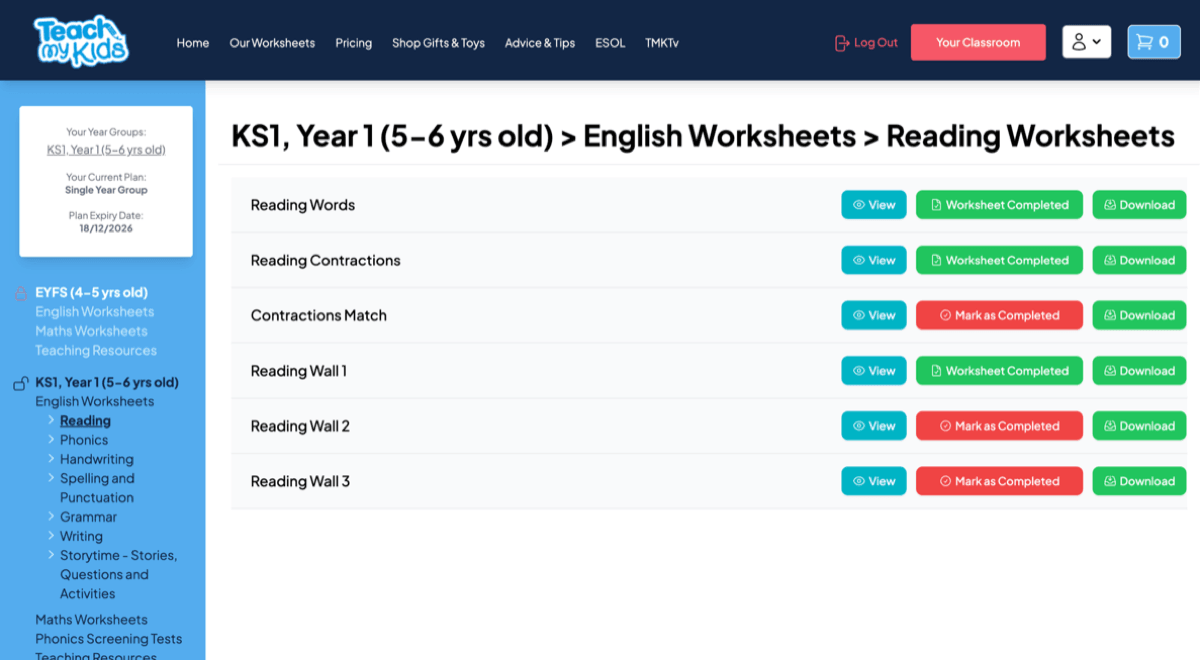
Mark each worksheet as done so you can see what your child has covered.
Common questions
Questions parents ask
- Are the worksheets made by a teacher?
- Yes. Every worksheet is created by an experienced UK primary school teacher and mapped to the national curriculum, so what your child practises lines up with school.
- How does Teach My Kids work?
- Set your child's year group and the matching maths and English worksheets unlock. Print what you need at home, sit together for ten minutes, then tick off what they have finished.
- Can I print the worksheets at home?
- Yes. They are built for paper, so you print them at home and your child works away from a screen. That is the whole point: structured practice, off the device.
From the kitchen table
From parents who already print at home.
Real parents, phonics through to SATs.

Putting Your Child's Education First


General
Worksheets by year and topic
- Reception maths worksheets
- Year 1 maths worksheets
- Year 2 maths worksheets
- Year 3 maths worksheets
- Year 4 maths worksheets
- Year 5 maths worksheets
- Year 6 maths worksheets
- Year 1 English worksheets
- Year 2 English worksheets
- Year 3 English worksheets
- Year 4 English worksheets
- Year 5 English worksheets
- Year 6 English worksheets
- Times tables worksheets
- Multiplication tables check
- Multiplication worksheets
- Division worksheets
- Fractions worksheets
- Decimals worksheets
- Percentages worksheets
- Place value worksheets
- Addition worksheets
- Subtraction worksheets
- Telling the time worksheets
- Shape worksheets
- Grammar worksheets
- Fronted adverbials
- Adverbs worksheets
- Nouns worksheets
- Verbs worksheets
- Adjectives worksheets
- Spelling worksheets
- Handwriting worksheets
- Phonics worksheets
- Phase 5 phonics
- KS2 SATs papers
- KS1 SATs papers
- Year 6 SATs
- Clauses
- Conjunctions
- Pronouns
- Determiners
- Modal verbs
- Apostrophes
- Punctuation worksheets
- Angles worksheets
- Symmetry worksheets
- Perimeter and area
- Rounding worksheets
- Roman numerals
- Negative numbers
- Money worksheets
- Sound buttons
- Tricky words
- Common exception words
- Browse all worksheets →
All rights reserved © Teach My Kids 2026. Site by BillyMedia, a Craft CMS developer