Free Maths Worksheet - Place Value Cards for making numbers and partitioning
Maths and English worksheets for your child's year group, made by Sunita, an experienced UK primary school teacher. Print them at home and sit together for ten minutes.
Free trial, no card
Every Year 2 maths worksheet, mapped to the curriculum
Sign up free, pick your child's year group and print 3 worksheets this week. Made by a UK primary school teacher, yours to use at the kitchen table.
- ✓Made by an experienced UK primary school teacher
- ✓Mapped to the national curriculum, Reception to Year 6
- ✓Print at home and work on paper, no screen needed
No card needed. One teacher, every worksheet.
What is Place Value?
How Do You Partition Numbers?
In maths, numbers have a place value. This can be units, tens, hundreds, thousands etc. A number can be broken down (partitioned) to show the value of each digit in the number, e.g. 429 = 400 + 20 + 9. Therefore the number 429 is made up of 4 hundreds, 2 tens and 9 units.
Place Value (knowing what each digit in a number is worth), plays an important part in KS1 maths and KS2 maths.
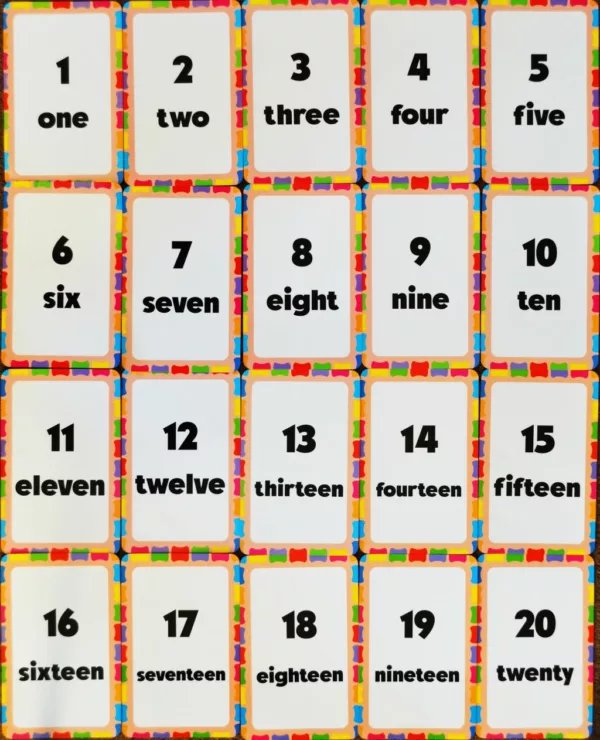
Regular use of place value cards will help children understand the number system, and aid the learning of addition and subtraction. Being able to partition numbers helps children add and take away numbers mentally and using written methods.
Primary schools teach place value and partitioning on an ongoing basis throughout the year.
A child confident with the place value of numbers will be able to calculate and solve problems quickly and easily.
Free Maths Worksheet - Partitioning Numbers.
Click on the download link below for your free maths worksheet containing place value cards.
This KS1 Maths and KS2 Maths Worksheet includes place value cards (to print out and cut). A clear explanation of how to use place value cards is also included. With four maths games and maths activities, you will be giving your child an excellent head start in maths.



Who makes the worksheets
Sunita
UK primary teacher
Every worksheet on Teach My Kids is made by Sunita, a UK primary school teacher with over ten years in the classroom. She writes each one by hand and maps it to the national curriculum, so what your child practises at home lines up with what they do at school. It's all on paper, not a screen, and takes about ten minutes a day.
Try the classroom freeWhat you're joining
This is your child's online classroom.
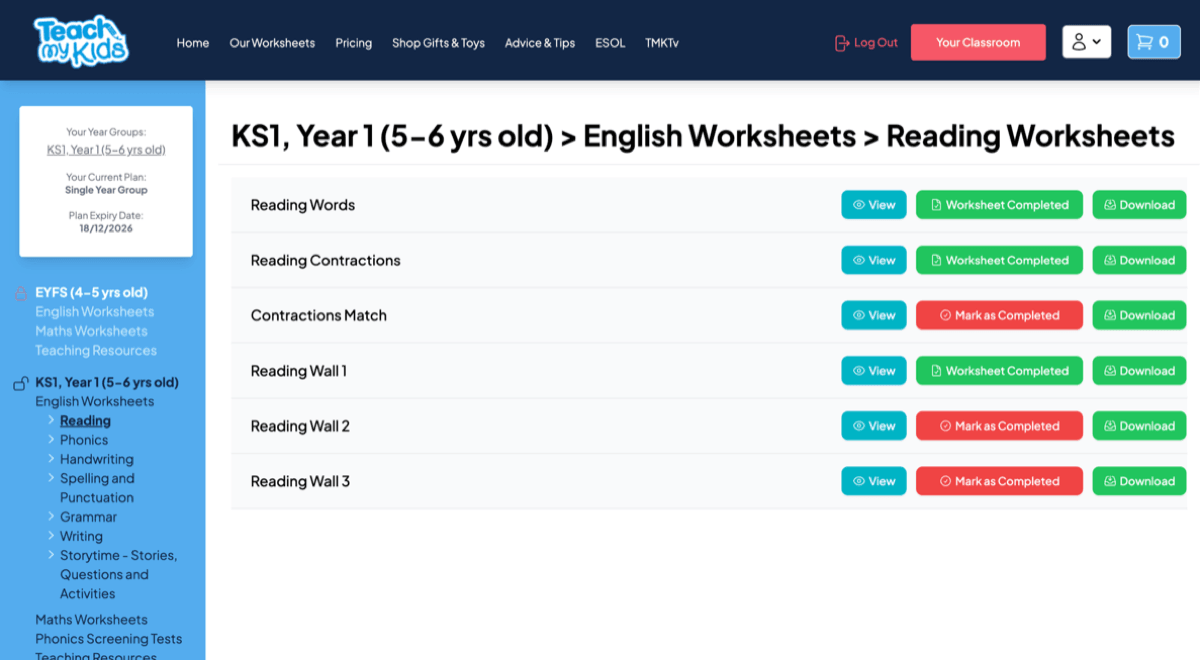
You're not buying a single worksheet. You log in to a space set up for your child, where the full Year 2 library unlocks and everything stays in one place.
-
1.
Your own space, any time.
A login for your family. No app to install. Open it whenever suits you.
-
2.
Set to your child's year.
Pick their year group and the right worksheets unlock. Move it up as they grow.
-
3.
The whole library unlocks.
Every worksheet for their year in maths and English, matched to the school curriculum and sorted by topic. Not one sheet, all of them.
-
4.
Print what you need, when you need it.
The whole library is open, so you print this week's topics when they come up at school. No daily limit and nothing to ration. Come back as often as you like.
-
5.
Tick off what's done.
Mark each worksheet as done so you can see what your child has covered.
Common questions
Questions parents ask
- What does partitioning mean in maths?
- Partitioning means splitting a number into its parts, usually hundreds, tens and units. So 342 becomes 300, 40 and 2. It helps a child see how numbers are built, which makes adding and subtracting easier.
- How do I teach place value at home?
- Start with real objects your child can group into tens and ones, then move to writing the numbers down. Ask what each digit is worth. In 56, the 5 is worth fifty, not five. Keep the numbers small at first, then build up.
- Why is partitioning useful?
- It makes bigger sums less daunting. Once a child can break a number into hundreds, tens and units, they can work on each part on its own, then put it back together. It is the thinking behind most written methods.
From the kitchen table
From parents who already print at home.
Real parents, phonics through to SATs.

Putting Your Child's Education First


General
Worksheets by year and topic
- Reception maths worksheets
- Year 1 maths worksheets
- Year 2 maths worksheets
- Year 3 maths worksheets
- Year 4 maths worksheets
- Year 5 maths worksheets
- Year 6 maths worksheets
- Year 1 English worksheets
- Year 2 English worksheets
- Year 3 English worksheets
- Year 4 English worksheets
- Year 5 English worksheets
- Year 6 English worksheets
- Times tables worksheets
- Multiplication tables check
- Multiplication worksheets
- Division worksheets
- Fractions worksheets
- Decimals worksheets
- Percentages worksheets
- Place value worksheets
- Addition worksheets
- Subtraction worksheets
- Telling the time worksheets
- Shape worksheets
- Grammar worksheets
- Fronted adverbials
- Adverbs worksheets
- Nouns worksheets
- Verbs worksheets
- Adjectives worksheets
- Spelling worksheets
- Handwriting worksheets
- Phonics worksheets
- Phase 5 phonics
- KS2 SATs papers
- KS1 SATs papers
- Year 6 SATs
- Clauses
- Conjunctions
- Pronouns
- Determiners
- Modal verbs
- Apostrophes
- Punctuation worksheets
- Angles worksheets
- Symmetry worksheets
- Perimeter and area
- Rounding worksheets
- Roman numerals
- Negative numbers
- Money worksheets
- Sound buttons
- Tricky words
- Common exception words
- Browse all worksheets →
All rights reserved © Teach My Kids 2026. Site by BillyMedia, a Craft CMS developer