Primary School SATs Results Explained
Maths and English worksheets for your child's year group, made by Sunita, an experienced UK primary school teacher. Print them at home and sit together for ten minutes.
Free trial, no card
Every Year 6 SATs topic, on paper
Sign up free, pick your child's year group and print 3 worksheets this week. Made by a UK primary school teacher, yours to use at the kitchen table.
- ✓Made by an experienced UK primary school teacher
- ✓Mapped to the national curriculum, Reception to Year 6
- ✓Print at home and work on paper, no screen needed
No card needed. One teacher, every worksheet.
SATs And How Primary School Children Are Assessed
Children at Primary School are assessed continuously. Most assessments are teacher assessments. This is where the class teacher will give all the children in the class a Maths and English assessment to complete. It is marked and given a level by the teacher. This is then recorded and used to inform future planning and can be shared with parents at a parents evening meeting or through reports that are sent home. Many schools will moderate the marking to ensure consistency throughout the school.
When Are Children Assessed More Formally?
During Year 2 and Year 6, children are assessed more formally and the levels achieved by each child is not only to inform future planning, but sent to the local authority.
What Levels Can Be Given To Children?
The table below shows the levels children are expected to achieve at the end of Year 2, Year 6 and Year 8.
How Do Teachers Decide On The Level To Give A Child?
Throughout the year, teachers assess children’s abilities in Maths and English. A piece of work will be given to the child to complete. This piece of work will be assessed using level descriptions from the National Curriculum. The level descriptions give targets or objectives the child must show in their work to achieve that level. If a certain objective can’t be seen in the work the child has produced, then that level hasn’t been achieved. The child may be working within a level, but not achieved it. At the end of the year, the teacher will summarise the levels from throughout the year and give an overall level for the year.
Year 2 SATs Levels Explained.
In Year 2, children are assessed for maths, reading, writing, speaking and listening. Parents should be told what their child’s SATs results are for each of these areas. At the end of Year 2, children are expected to achieve a Level 2b. Level 2c and Level 1a/b/c are considered to below the expected level. Level 3 means your child is working above the expected levels for their age.
If a child achieves Level 2b in Year 2, they are predicted to achieve Level 4b at year 6 and are on the right track.
Year 6 SATs Levels Explained
Children are expected to leave Primary School having achieved a Level 4 in Maths and English. If a Level 5 is achieved, they are working beyond the expected level. A Level 6 is exceptional. More able children can be given the chance to take a Level 6 SATs papers.
Do SATs Results Matter?
Year 2 SATs
The level a child achieves at Year 2 is mainly used to help inform teachers planning and to give parents an idea of how their child is progressing at school. Schools use these results to predict which children will achieve the expected Level 4 in Year 6.
You might find your child’s SATs level is lower than you expected in Year 2. Some schools give children a lower level at Year 2, so that when the children achieve a higher than expected level in Year 6, the school’s ‘value added’ score is higher. This means that the amount of progress made by the children between Year 2 and Year 6 is higher, making the school look better in the league tables. This doesn’t happen in all schools, but it is not unheard of.
Year 6 SATs
The level a child achieves at Year 6 is used to give parents an idea how their child has progressed. The results can also be used by Secondary schools to help them put children into the appropriate set or group. Some Secondary schools prefer not to use these results and will assess them again. Year 6 SATs results are also used in School League tables and can be used to compare one school against another. They also show how children are achieving when compared to other children/schools nationally and regionally.



Who makes the worksheets
Sunita
UK primary teacher
Every worksheet on Teach My Kids is made by Sunita, a UK primary school teacher with over ten years in the classroom. She writes each one by hand and maps it to the national curriculum, so what your child practises at home lines up with what they do at school. It's all on paper, not a screen, and takes about ten minutes a day.
Try the classroom freeWhat you're joining
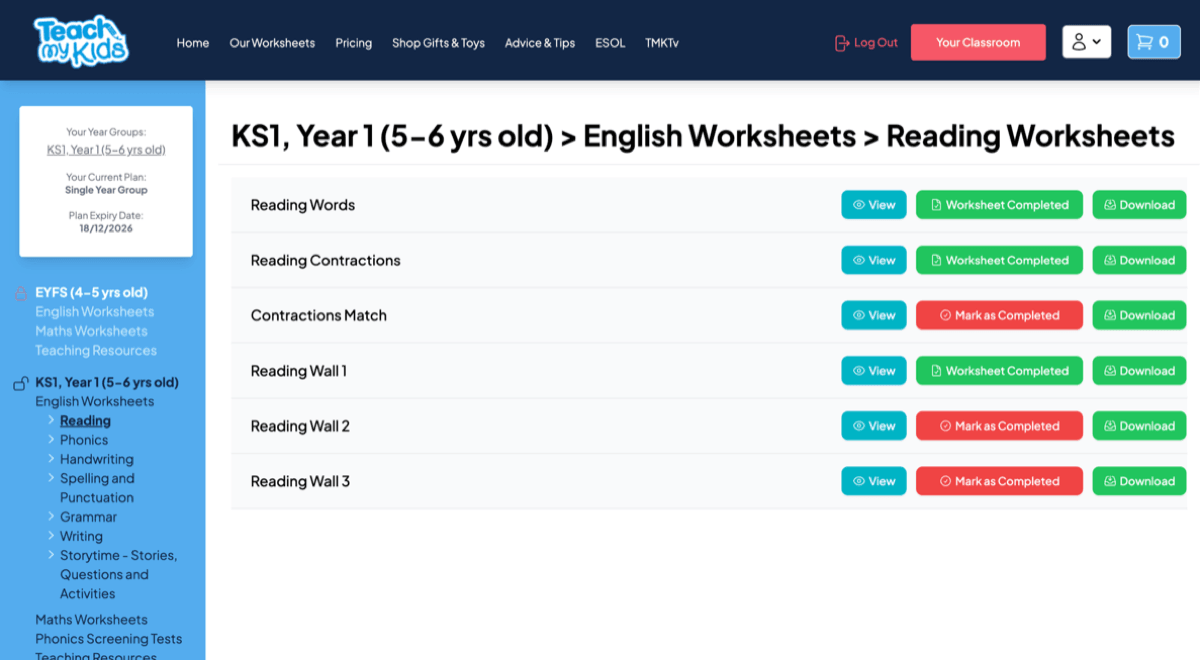
This is your child's online classroom.
You're not buying a single worksheet. You log in to a space set up for your child, where the full Year 6 library unlocks and everything stays in one place.
-
1.
Your own space, any time.
A login for your family. No app to install. Open it whenever suits you.
-
2.
Set to your child's year.
Pick their year group and the right worksheets unlock. Move it up as they grow.
-
3.
The whole library unlocks.
Every worksheet for their year in maths and English, matched to the school curriculum and sorted by topic. Not one sheet, all of them.
-
4.
Print what you need, when you need it.
The whole library is open, so you print this week's topics when they come up at school. No daily limit and nothing to ration. Come back as often as you like.
-
5.
Tick off what's done.
Mark each worksheet as done so you can see what your child has covered.
Common questions
Questions parents ask
- Are the worksheets made by a teacher?
- Yes. Every worksheet is created by an experienced UK primary school teacher and mapped to the national curriculum, so what your child practises lines up with school.
- How does Teach My Kids work?
- Set your child's year group and the matching maths and English worksheets unlock. Print what you need at home, sit together for ten minutes, then tick off what they have finished.
- Can I print the worksheets at home?
- Yes. They are built for paper, so you print them at home and your child works away from a screen. That is the whole point: structured practice, off the device.
From the kitchen table
From parents who already print at home.
Real parents, phonics through to SATs.

Putting Your Child's Education First


General
Worksheets by year and topic
- Reception maths worksheets
- Year 1 maths worksheets
- Year 2 maths worksheets
- Year 3 maths worksheets
- Year 4 maths worksheets
- Year 5 maths worksheets
- Year 6 maths worksheets
- Year 1 English worksheets
- Year 2 English worksheets
- Year 3 English worksheets
- Year 4 English worksheets
- Year 5 English worksheets
- Year 6 English worksheets
- Times tables worksheets
- Multiplication tables check
- Multiplication worksheets
- Division worksheets
- Fractions worksheets
- Decimals worksheets
- Percentages worksheets
- Place value worksheets
- Addition worksheets
- Subtraction worksheets
- Telling the time worksheets
- Shape worksheets
- Grammar worksheets
- Fronted adverbials
- Adverbs worksheets
- Nouns worksheets
- Verbs worksheets
- Adjectives worksheets
- Spelling worksheets
- Handwriting worksheets
- Phonics worksheets
- Phase 5 phonics
- KS2 SATs papers
- KS1 SATs papers
- Year 6 SATs
- Clauses
- Conjunctions
- Pronouns
- Determiners
- Modal verbs
- Apostrophes
- Punctuation worksheets
- Angles worksheets
- Symmetry worksheets
- Perimeter and area
- Rounding worksheets
- Roman numerals
- Negative numbers
- Money worksheets
- Sound buttons
- Tricky words
- Common exception words
- Browse all worksheets →
All rights reserved © Teach My Kids 2026. Site by BillyMedia, a Craft CMS developer