Story Ideas - Characters, Settings, Objects and Interesting Words Helpsheet
Maths and English worksheets for your child's year group, made by Sunita, an experienced UK primary school teacher. Print them at home and sit together for ten minutes.
Free trial, no card
Every grammar and writing worksheet for Year 3, in one place
Sign up free, pick your child's year group and print 3 worksheets this week. Made by a UK primary school teacher, yours to use at the kitchen table.
- ✓Made by an experienced UK primary school teacher
- ✓Mapped to the national curriculum, Reception to Year 6
- ✓Print at home and work on paper, no screen needed
No card needed. One teacher, every worksheet.
Story Writing Ideas
Don't know what to write a story about?
Sometimes the hardest part of story writing is thinking of ideas and finding a starting point. Helping children generate ideas for stories can be a fun and exciting way to foster their creativity.
Here are some ideas to get those creative juices flowing.
- Brainstorm Together:
Sit down with your child and have a casual brainstorming session. Encourage them to share any thoughts that come to mind, even if they seem silly or unrelated. Sometimes, the most imaginative stories emerge from unexpected ideas. - Inspiration from Everyday Life:
Encourage your child to draw inspiration from their own experiences. Ask questions about exciting or memorable events in their lives, and discuss how they can turn those moments into a captivating story. Personal connections often make stories more engaging. - Picture Prompts:
Provide a selection of interesting or whimsical pictures. These could be images from magazines, online sources, or even drawings. Ask your child to choose a picture that sparks their imagination and build a story around it. - Character Creation:
Help your child develop interesting characters by discussing their personalities, quirks, and backgrounds. Once they have a character in mind, the story can revolve around the adventures and challenges their character faces. - Change the Perspective:
Explore different perspectives for storytelling. For instance, suggest they write a story from the viewpoint of an animal, an inanimate object, or even from the past or future. Changing perspectives can open up new and exciting possibilities. - Mix and Match:
Combine unrelated elements to create a unique story. For example, ask your child to choose a setting, a character, and a problem from different categories. Then, challenge them to weave these elements together into a cohesive and interesting narrative. - What If Scenarios:
Encourage your child to think about "What if" scenarios. What if they could fly? What if animals could talk? What if they discovered a magical portal in their backyard? These imaginative scenarios can lead to creative and fantastical stories. - Story Cubes or Dice:
Use story cubes or dice with pictures or words on each side. Have your child roll the dice and create a story based on the images or words that come up. It adds an element of randomness and can spark unexpected ideas.
Remember, the goal is to make the process enjoyable and to nurture children's creativity. Celebrate their ideas, no matter how wild or unconventional, and encourage them to let their imagination run wild when crafting their stories.
Free Story Ideas HelpSheet For Children
This helpsheet will give children ideas for characters, settings, objects and interesting words. All of these story ideas will help KS1 and KS2 children get started when planning and writing a story. It will also encourage children to write more interesting stories.
Download Your Free Story Ideas Helpsheet
Join Teach My Kids for targeted English Worksheets for Primary School Children



Who makes the worksheets
Sunita
UK primary teacher
Every worksheet on Teach My Kids is made by Sunita, a UK primary school teacher with over ten years in the classroom. She writes each one by hand and maps it to the national curriculum, so what your child practises at home lines up with what they do at school. It's all on paper, not a screen, and takes about ten minutes a day.
Try the classroom freeWhat you're joining
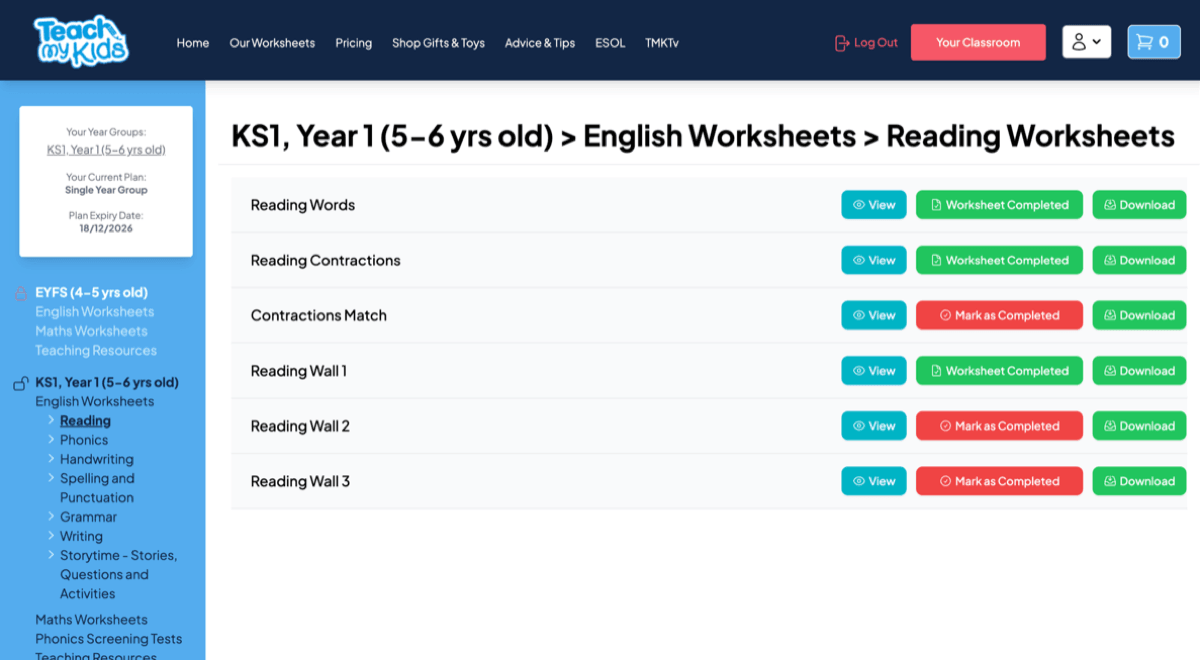
This is your child's online classroom.
You're not buying a single worksheet. You log in to a space set up for your child, where the full Year 3 library unlocks and everything stays in one place.
-
1.
Your own space, any time.
A login for your family. No app to install. Open it whenever suits you.
-
2.
Set to your child's year.
Pick their year group and the right worksheets unlock. Move it up as they grow.
-
3.
The whole library unlocks.
Every worksheet for their year in maths and English, matched to the school curriculum and sorted by topic. Not one sheet, all of them.
-
4.
Print what you need, when you need it.
The whole library is open, so you print this week's topics when they come up at school. No daily limit and nothing to ration. Come back as often as you like.
-
5.
Tick off what's done.
Mark each worksheet as done so you can see what your child has covered.
Common questions
Questions parents ask
- What is the difference between a verb and an adverb?
- A verb is the action or doing word, like run, think or jump. An adverb describes that verb and tells you how, when or where it happened, like quickly, yesterday or outside.
- How can I help my child with writing at home?
- Talk the idea through before they pick up a pencil. Planning out loud takes the pressure off the blank page. Keep the pieces short, praise one thing they did well, then let them read it back to you.
- What is a story mountain?
- A story mountain is a simple plan that splits a story into five parts: the opening, the build-up, the problem, the resolution and the ending. It helps a child see the shape of a story before they start writing.
From the kitchen table
From parents who already print at home.
Real parents, phonics through to SATs.

Putting Your Child's Education First


General
Worksheets by year and topic
- Reception maths worksheets
- Year 1 maths worksheets
- Year 2 maths worksheets
- Year 3 maths worksheets
- Year 4 maths worksheets
- Year 5 maths worksheets
- Year 6 maths worksheets
- Year 1 English worksheets
- Year 2 English worksheets
- Year 3 English worksheets
- Year 4 English worksheets
- Year 5 English worksheets
- Year 6 English worksheets
- Times tables worksheets
- Multiplication tables check
- Multiplication worksheets
- Division worksheets
- Fractions worksheets
- Decimals worksheets
- Percentages worksheets
- Place value worksheets
- Addition worksheets
- Subtraction worksheets
- Telling the time worksheets
- Shape worksheets
- Grammar worksheets
- Fronted adverbials
- Adverbs worksheets
- Nouns worksheets
- Verbs worksheets
- Adjectives worksheets
- Spelling worksheets
- Handwriting worksheets
- Phonics worksheets
- Phase 5 phonics
- KS2 SATs papers
- KS1 SATs papers
- Year 6 SATs
- Clauses
- Conjunctions
- Pronouns
- Determiners
- Modal verbs
- Apostrophes
- Punctuation worksheets
- Angles worksheets
- Symmetry worksheets
- Perimeter and area
- Rounding worksheets
- Roman numerals
- Negative numbers
- Money worksheets
- Sound buttons
- Tricky words
- Common exception words
- Browse all worksheets →
All rights reserved © Teach My Kids 2026. Site by BillyMedia, a Craft CMS developer