
Lower Key Stage 2
Year 4 maths and English worksheets.
The maths and English worksheets for Year 4, made by Sunita, an experienced UK primary school teacher, and mapped to the national curriculum. Pick one, print it, and sit with your child for ten minutes.
Times tables check ready, fractions and decimals, SPaG. Join and the full Year 4 library unlocks straight away.
One yearly payment. No subscription.
A look inside
See a few before you join.
Real worksheets from the Year 4 library. This is exactly what you print at home.


Get the full Year 4 library.
One payment covers the whole school year. Print what you need, when you need it. Nothing renews.
Inside Year 4
Everything in the Year 4 library.
Sorted by subject then topic. Open a topic to see the worksheets.
English Worksheets
- Spelling Word List - Year 4
- Homophones - Choose the Correct Word (1)
- Homophones - Choose the Correct Word (2)
- Homophones Wordsearch
- Misused Homophones
- Using Speech Marks (3)
- Using Speech Marks (4)
- Speech Marks - Punctuation
- Silent Letters - b
- Silent Letters - t
- Silent Letters - w
- Synonyms - Words with the Same Meanings (1)
- Synonyms - Words with the Same Meanings (2)
- Synonyms - Words with the Same Meanings (3)
- Using Apostrophes - Contractions in Sentences
- Possessive Apostrophes
- Vocabulary Extension - Reach for the Stars (Verbs)
- Vocabulary Extension - Reach for the Stars (Adjectives)
- Adverbs 1
- Adverbs 2
- Adjectives to Adverbs
- Writing Interesting Sentences - Adjectives and Adverbs
- Using Verbs and Adverbs in a Sentence (2)
- Pronouns 1
- Pronouns 2
- Pronouns - Singular and Plural
- What is a Deteminer?
- Choose a Determiner
- What is 1st, 2nd, 3rd Person?
- Sentences - 1st Person to 3rd Person
- Sentences - 3rd Person to 1st Person
- Report Writing - Good and Bad Sentences (1)
- Report Writing - Good and Bad Sentences (2)
- Learning to Use Different Conjunctions (1)
- Using Connectives in a Sentence
- Modifiers - Noun Modifiers
- Modifiers as Adjectives
- Modifiers as Adverbs (1)
- Modifiers as Adverbs (2)
- Making Sentences More Interesting (2)
- Complex Sentences - Relative Clauses
- Complex Sentences - Adverbial Clauses
- Complex Sentences - Adverbial Clauses and Speech
- Simple, Compound, Complex Sentences
- Words to Use Instead of 'said'
- Check Your Work (3)
- Alliteration - Number Challenge
- What is a Simile?
- How to Use a Simile in a Sentence
- Metaphors - Find the Metaphors
- Metaphors - What Do They Mean?
- Retelling Stories
- Create Your Own Characters - Character Profile
- Cartoon Strip - Escape from the Zoo
- Story Mountain – Planning and Writing a Story
- My Imaginary World
- My Imaginary Characters
- Writing a Story Set in an Imaginary World - Planning
- Writing a Story Set in an Imaginary World
- Fairy Tales Daily (1)
- Fairy Tales Daily (2)
- Dilemmas - What Should You Do?
- Writing a Story with a Dilemma - Planning
- Writing a Story with a Dilemma
- Paragraphs (1)
- Paragraphs (2)
- Paragraphs (3)
- Writing Paragraphs - Animals
- Writing Paragraphs - Weather
- Writing a Recount - My Day
- Writing a Recount - My Journey to School
- Fact or Opinion - You Decide
- Write a Newspaper Article - Goldilocks
- Write a Newspaper Article - Animals Escape
- Writing an Explanation - Games Challenge
- Make You Own Postcard
- Writing a Balanced Discussion - Mobile Phones
- Writing a Balanced Discussion - Home Alone
Maths Worksheets
- Place Value - Abacus (Th, H, T, U)
- Place Value - 2, 3, 4 Digit Numbers
- Partitioning 4 Digit Numbers
- Ordering Numbers Over 1000
- Place Value and Making 4 Digit Numbers
- Counting and Understanding Numbers
- Estimating and Using Number Facts
- Roman Numerals - The Basic (1)
- Roman Numerals - The Basics (2)
- Roman Numerals - The Basics (3)
- Using Roman Numerals - No's to 100
- Number Triangles (+ -)
- Number Machines - Inverse Operations (+ -)
- Adding Larger Numbers - Number Line
- Addition by Partitioning Numbers Over 100 (6)
- Addition using Expanded Column Method 2
- Addition using Expanded Column Method 2 (extra practise)
- Addition using Expanded Column Method 3
- Addition - Traditional Carrying Method 1
- Addition, Column Method HTU
- Addition, Column Method HTU (extra practise)
- Addition – Any Way You Like!
- Adding Money - Sunday Treat
- Take Away Numbers Over 100 - Number Line 2
- Take Away Numbers Over 100 - Number Line 3
- Take Away by Partitioning Numbers Over 100 (5)
- Take Away - Using Partitioning (extra Practise)
- Subtraction - Expanded Column Method 2
- Subtraction - Expanded Column Method 2 (extra practise)
- Subtraction - Expanded Column Method 3
- Subtraction - Expanded Column Method HTU (extra practise)
- Subtraction - Column Method (Muncher's Party)
- Take Away – Any Way You Like!
- Times Tables Patterns (x3 x6)
- Times Tables Practise - x6
- Times Tables Practise - x7
- Times Tables Practise x8
- Grid Method Multiplication
- Grid Method Multiplication - Ribbons
- Number Squares - Inverse Operations (x ÷)
- Times Tables Practise - x9
- Times Tables Patterns (x9)
- Times Tables Bingo - Easy (x6, x7, x8, x9)
- Number Machines - Inverse Operations ( x ÷)
- Multiply / Divide by 10, 100
- Multiply / Divide by 10, 100, 1000
- Expanded Short Multiplication (TU)
- Expanded Short Multiplication TU (extra practise)
- At the Seaside – Expanded Short Multiplication
- Short Multiplication (TU)
- Short Multiplication (HTU)
- Short Multiplication - HTU (extra practise)
- Short Multiplication - Check it Yourself
- Short Multiplication - Decimal Numbers
- Timed Times Tables Practise
- Times Tables Practise - x11
- Times Tables Patterns (x11)
- Times Tables Practise - x12
- Times Tables Square - Blank and Filled In (up to x12)
- Times Tables Bingo - Hard (x6, x7, x8, x9)
- Division Bingo (6, 7, 8 ,9)
- Division Clouds - Divide by 6, 7, 8, 9
- Division - Repeated Subtraction with Remainders
- Division - Repeated Subtraction with Remainders (extra practise)
- Division - Using Times Tables Facts
- Division - Using Times Tables Facts (extra practise)
- Division Using the Chunking Method 1
- Division – Chunking Method TU (Extra Practise)
- Chunking Method Division – The Stars and Beyond!
- Division Using the Chunking Method - HTU
- Division – Chunking Method HTU (Extra Practise)
- Chunking Method Division (HTU) – Ten Pin Bowling
- Ordering Decimal Numbers - Tenths
- Ordering Decimal Numbers - Tenths / Hundredths
- Changing Pence to Pounds
- Changing Pounds to Pence
- Rounding to the Nearest £
- Writing and Ordering Decimal Numbers / Fractions
- Fractions Wall and Equivalent Fractions
- Recognising Equivalent Fractions
- Finding Fractions of a Number
- Fractions and Numberlines
- Fractions of a Number
- Word Problems - Times and Divide
- Multiplication and Division Problems
- Problem Solving - Money
- Puzzle Squares
- Monster Problems 2
- Mixed Word Problems
- Word Problems (add, subtract, times, divide)
- Problem Solving - 2 Step Problems
- Mental Maths and Fraction Problems
- Derive and Recall - Times / Divide Facts
- One and Two Step Problems
- Number and Shape Patterns / Relationships
- 3D Shapes
- Make Your Own Cube
- Make Your Own Pyramid
- Troublesome Triangles
- Triangles Quiz
- Quirky Quadrilaterals
- Quadrilaterals Quiz
- Polygon or Not?
- Regular Polygons
- Regular Polygons and Irregular Polygons
- Understanding 2D and 3D Shapes
- Identifying Lines of Symmetry
- Symmetrical Reflections
- More Symmetrical Reflections
- Drawing Symmetrical Reflections
- Symmetry and Reflections
- Right Angle or Not?
- Is It An Acute Angle?
- Obviously Obtuse Angles!
- Comparing Acute Angles, Right Angles & Obtuse Angles
- Ordering Acute Angles, Right Angles & Obtuse Angles (1)
- Ordering Acute Angles, Right Angles & Obtuse Angles (2)
- Ordering Acute Angles, Right Angles & Obtuse Angles (3)
- Ordering Acute Angles, Right Angles & Obtuse Angles (4)
- Drawing & Ordering Acute Angles, Right Angles & Obtuse Angles
- Drawing Quadrilaterals
- Regular Polygons - Drawing Skills
- Finish the Polygon
- Plot the Polygon Points
- Coordinates - Drawing a Grid
- Reading Coordinates
- Reading Coordinates - Practise
- Reading Coordinates - What is it?
- Plotting Coordinates
- Plotting Coordinates - Practise
- Plotting Coordinates - 2D Shapes
- Plotting Coordinates - More 2D Shapes
- Plotting and Reading Coordinates - House
- Co-ordinates and Compass Points
Ready to start Year 4?
£17.49 for the school year. Pick a worksheet, print it, sit down together.
Why this works
Ten quiet minutes on paper.
Multiplication tables check is the focus for Year 4. Pick the worksheet, sit with your child for ten minutes, close the folder. The page sits still. The screen scrolls, dims, and notifies.
Handwriting research at NTNU and a 2018 paper-versus-screen meta-analysis both find children comprehend and remember more on paper than the same words on a tablet. That is why TeachMyKids is printable, not an app.
Read the researchYear 4 access
£17.49/year
What you're joining
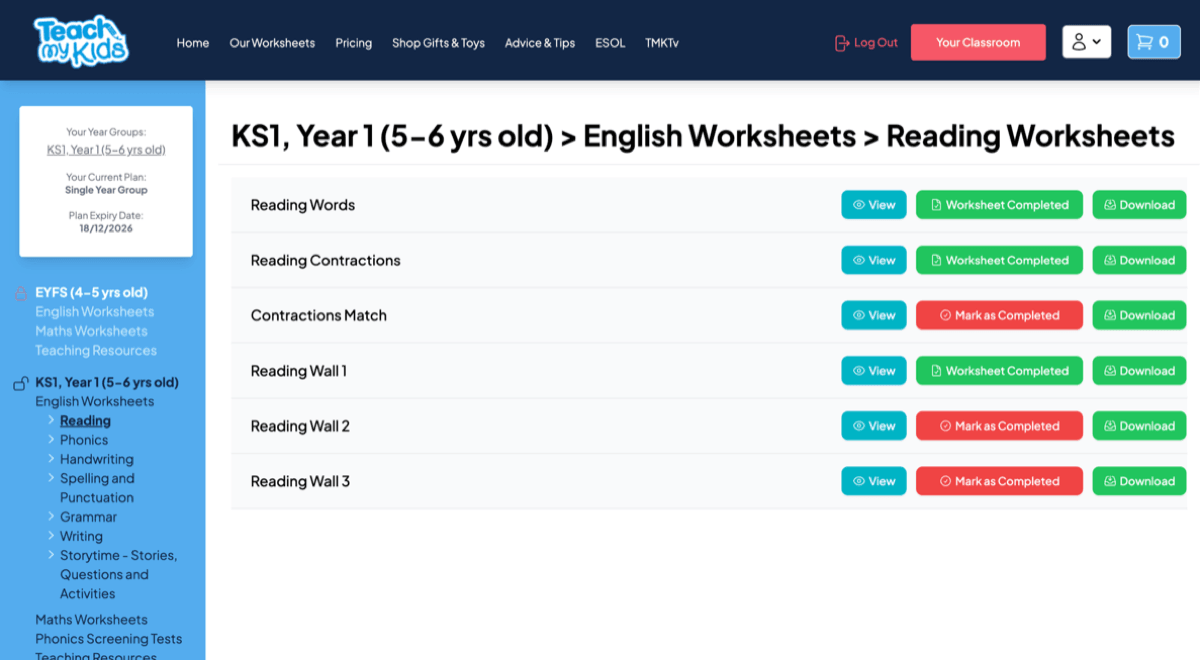
This is your child's online classroom.
You're not buying a single worksheet. You log in to a space set up for your child, where the full Year 4 library unlocks and everything stays in one place.
-
1.
Your own space, any time.
A login for your family. No app to install. Open it whenever suits you.
-
2.
Set to your child's year.
Pick their year group and the right worksheets unlock. Move it up as they grow.
-
3.
The whole library unlocks.
Every worksheet for their year in maths and English, matched to the school curriculum and sorted by topic. Not one sheet, all of them.
-
4.
Print what you need, when you need it.
The whole library is open, so you print this week's topics when they come up at school. No daily limit and nothing to ration. Come back as often as you like.
-
5.
Tick off what's done.
Mark each worksheet as done so you can see what your child has covered.
Ready to start with Year 4?
£17.49 for the school year, or £74.99 covers every year group for every child.
See plansFrom the kitchen table
From parents who already print at home.
Real parents, phonics through to SATs.

Putting Your Child's Education First


General
Worksheets by year and topic
- Reception maths worksheets
- Year 1 maths worksheets
- Year 2 maths worksheets
- Year 3 maths worksheets
- Year 4 maths worksheets
- Year 5 maths worksheets
- Year 6 maths worksheets
- Year 1 English worksheets
- Year 2 English worksheets
- Year 3 English worksheets
- Year 4 English worksheets
- Year 5 English worksheets
- Year 6 English worksheets
- Times tables worksheets
- Multiplication tables check
- Multiplication worksheets
- Division worksheets
- Fractions worksheets
- Decimals worksheets
- Percentages worksheets
- Place value worksheets
- Addition worksheets
- Subtraction worksheets
- Telling the time worksheets
- Shape worksheets
- Grammar worksheets
- Fronted adverbials
- Adverbs worksheets
- Nouns worksheets
- Verbs worksheets
- Adjectives worksheets
- Spelling worksheets
- Handwriting worksheets
- Phonics worksheets
- Phase 5 phonics
- KS2 SATs papers
- KS1 SATs papers
- Year 6 SATs
- Clauses
- Conjunctions
- Pronouns
- Determiners
- Modal verbs
- Apostrophes
- Punctuation worksheets
- Angles worksheets
- Symmetry worksheets
- Perimeter and area
- Rounding worksheets
- Roman numerals
- Negative numbers
- Money worksheets
- Sound buttons
- Tricky words
- Common exception words
- Browse all worksheets →
All rights reserved © Teach My Kids 2026. Site by BillyMedia, a Craft CMS developer