Easter Activities for Kids - Craft, baking and writing ideas for Easter
Maths and English worksheets for your child's year group, made by Sunita, an experienced UK primary school teacher. Print them at home and sit together for ten minutes.
Free trial, no card
Every grammar and writing worksheet for Year 3, in one place
Sign up free, pick your child's year group and print 3 worksheets this week. Made by a UK primary school teacher, yours to use at the kitchen table.
- ✓Made by an experienced UK primary school teacher
- ✓Mapped to the national curriculum, Reception to Year 6
- ✓Print at home and work on paper, no screen needed
No card needed. One teacher, every worksheet.
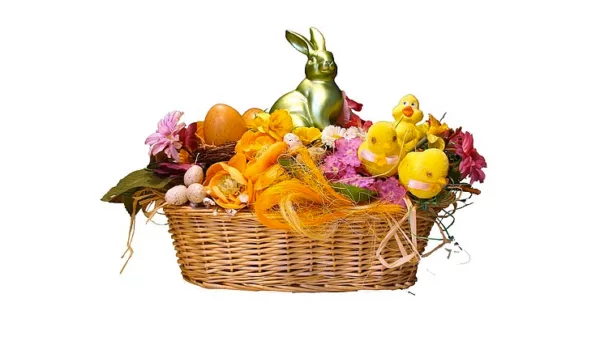
Easter is a lovely time of year. With winter behind us, longer days and gardens starting to look green and colourful again, its a time to spring back into action.
Easter holidays can be very hit and miss - if the weather is nice, you can take the kids out for walks, visiting farms and parks, or if you are feeling energetic, take them out for a bike ride. Out in the garden, children can help you plant bulbs and plants - they will love to watch them grow as Spring turns into Summer. But if it rains, parents have the tough task of keeping the kids entertained.
Here are 10 fun Easter activities to try out with the kids.
Easter Craft Ideas
1. Cress Egg Heads.
Put some damp cotton wool into the base of an empty eggshell or yogurt pot. Children can draw a face on to the eggshell or yogurt pot with a permanent felt pen. Sprinkle some cress seeds onto the cotton wool and watch the seeds grow. It will take about a week to grow.Once the cress has grown, kids can use it to make their own sandwiches.
2. Thumbprint chicks.
Make your own Easter cards. Using yellow paint, put thumbprints onto a piece of A4 card folded in half. The print can go anywhere on the card. Once the thumbprints are dry, draw the features of a chick using a black pen or thin felt pen. You can use dots for the eyes, a triangle for the beak and some stick legs.
3. Pasta and Lentil Easter Eggs.
You will need PVA glue, dry pasta and different coloured lentils or rice (coloured using food colouring). Draw the outline of an Easter egg onto A4 paper or card. Draw some patterns onto it e.g zigzag, waves, circles, a bow... Use the pasta, rice and lentils to fill in the patterns.
4. Design Your Own Easter Basket.
Click on the link at the end of this article to download an empty Easter basket. Use your imagination to fill the basket with Easter treats.
5. Easter Picture - Copy and Colour.
Boast your drawing skills. Click on the link at the end of this article to download an Easter picture. Copy the Easter picture as accurately as possible. Add spring features to the pictures.
6. Easter Egg Colouring.
Get creative. Click on the link at the end of this article to download a free Easter Egg colouring worksheet.
Colour the Easter eggs using crayons or felt pens. Draw your own Easter eggs and patterns. Take it to the next level by trying to make your Easter eggs look 3D by using pencil crayon shading techniques. Make the lower parts of the eggs a darker shade than the top.
Easter Baking Ideas
7. Chocolate Nests.
You will need a bar of milk chocolate, either Cornflakes or broken Shredded Wheat, paper cake cups and mini chocolate eggs. Melt the chocolate in a glass bowl, over some hot water. When melted, mix in the cornflakes or shredded wheat. Place the chocolate mix into the cake cups, use your thumb to make a dip in the middle. Place them in the fridge to cool and harden. Once cooled, put the chocolate eggs into the nests.
8. Easter Biscuits.
You will need chick or rabbit shaped biscuit cutters. Using a standard biscuit mixture, make your biscuits. Decorate using icing, silver balls, sugar strands etc.
Click here for a biscuit recipe.
Easter Writing Activities
9. The Great Easter Egg Hunt.
You will need mini chocolate eggs to hide. Hide the chocolate eggs around the house. Write some clues for someone to find the eggs. The clues can be written as an anagram (e.g. under the stairs = duenr het rstisa), as a code (e.g. a=1 b=2 c=3, so box = 2,15,24) or riddles (e.g. in the dark its very cold, open the door and let the light shine).
10.The Case of the Missing Easter Rabbit.
Finish the story. It started off as a normal Easter Sunday. Tilly skipped along the garden path to feed her pet rabbit with left over salad. But he wasn't there! All she could see was some colorful eggshells scattered over the grass. Tilly followed the trail of shell. Suddenly she fell down an enormous hole. Down she tumbled until she ...



Who makes the worksheets
Sunita
UK primary teacher
Every worksheet on Teach My Kids is made by Sunita, a UK primary school teacher with over ten years in the classroom. She writes each one by hand and maps it to the national curriculum, so what your child practises at home lines up with what they do at school. It's all on paper, not a screen, and takes about ten minutes a day.
Try the classroom freeWhat you're joining
This is your child's online classroom.
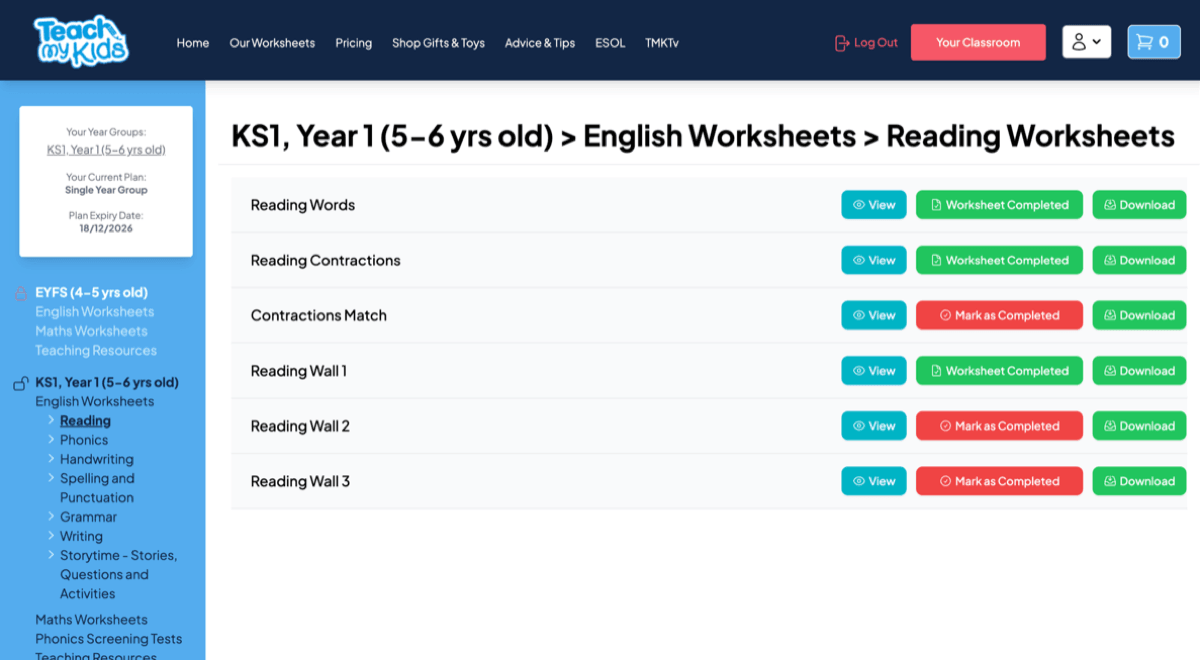
You're not buying a single worksheet. You log in to a space set up for your child, where the full Year 3 library unlocks and everything stays in one place.
-
1.
Your own space, any time.
A login for your family. No app to install. Open it whenever suits you.
-
2.
Set to your child's year.
Pick their year group and the right worksheets unlock. Move it up as they grow.
-
3.
The whole library unlocks.
Every worksheet for their year in maths and English, matched to the school curriculum and sorted by topic. Not one sheet, all of them.
-
4.
Print what you need, when you need it.
The whole library is open, so you print this week's topics when they come up at school. No daily limit and nothing to ration. Come back as often as you like.
-
5.
Tick off what's done.
Mark each worksheet as done so you can see what your child has covered.
Common questions
Questions parents ask
- What is the difference between a verb and an adverb?
- A verb is the action or doing word, like run, think or jump. An adverb describes that verb and tells you how, when or where it happened, like quickly, yesterday or outside.
- How can I help my child with writing at home?
- Talk the idea through before they pick up a pencil. Planning out loud takes the pressure off the blank page. Keep the pieces short, praise one thing they did well, then let them read it back to you.
- What is a story mountain?
- A story mountain is a simple plan that splits a story into five parts: the opening, the build-up, the problem, the resolution and the ending. It helps a child see the shape of a story before they start writing.
From the kitchen table
From parents who already print at home.
Real parents, phonics through to SATs.

Putting Your Child's Education First


General
Worksheets by year and topic
- Reception maths worksheets
- Year 1 maths worksheets
- Year 2 maths worksheets
- Year 3 maths worksheets
- Year 4 maths worksheets
- Year 5 maths worksheets
- Year 6 maths worksheets
- Year 1 English worksheets
- Year 2 English worksheets
- Year 3 English worksheets
- Year 4 English worksheets
- Year 5 English worksheets
- Year 6 English worksheets
- Times tables worksheets
- Multiplication tables check
- Multiplication worksheets
- Division worksheets
- Fractions worksheets
- Decimals worksheets
- Percentages worksheets
- Place value worksheets
- Addition worksheets
- Subtraction worksheets
- Telling the time worksheets
- Shape worksheets
- Grammar worksheets
- Fronted adverbials
- Adverbs worksheets
- Nouns worksheets
- Verbs worksheets
- Adjectives worksheets
- Spelling worksheets
- Handwriting worksheets
- Phonics worksheets
- Phase 5 phonics
- KS2 SATs papers
- KS1 SATs papers
- Year 6 SATs
- Clauses
- Conjunctions
- Pronouns
- Determiners
- Modal verbs
- Apostrophes
- Punctuation worksheets
- Angles worksheets
- Symmetry worksheets
- Perimeter and area
- Rounding worksheets
- Roman numerals
- Negative numbers
- Money worksheets
- Sound buttons
- Tricky words
- Common exception words
- Browse all worksheets →
All rights reserved © Teach My Kids 2026. Site by BillyMedia, a Craft CMS developer