Instruction Writing for Crossing the Road - Worksheets
Maths and English worksheets for your child's year group, made by Sunita, an experienced UK primary school teacher. Print them at home and sit together for ten minutes.
Free trial, no card
Every grammar and writing worksheet for Year 3, in one place
Sign up free, pick your child's year group and print 3 worksheets this week. Made by a UK primary school teacher, yours to use at the kitchen table.
- ✓Made by an experienced UK primary school teacher
- ✓Mapped to the national curriculum, Reception to Year 6
- ✓Print at home and work on paper, no screen needed
No card needed. One teacher, every worksheet.

Develop writing skills in Literacy. Non-Fiction writing is a key part of the Literacy Framework for Primary Schools. Non-fiction writing includes: letters, instructions, reports, newspaper articles etc.
Teach My Kids - Activities for children: Talk about, show and write about how to cross the road.
Teaching children how to write effective instructional texts is part of the Literacy curriculum, especially for practical tasks like crossing the road safely. Read on to find out how to teach and use instructional writing based on the primary National Curriculum objectives and improving children's writing skills.
National Curriculum Objectives for Instructional Writing (5 - 7 Year Old Children)
The National Curriculum for English has several key areas that relate directly to instruction writing:
- Writing for Different Purposes:
Objective: Write for different purposes, including instructions.
Teaching Strategy: Introduce different types of writing through examples, such as instructional texts for daily tasks (e.g. crossing the road). - Using the Correct Vocabulary:
Objective: Use a range of vocabulary appropriate to the task.
Teaching Strategy: Create a word bank of verbs and safety-related terms. Engage children in activities that incorporate these words into their writing. This can also be done through play and role play activities. - Text Structure:
Objective: Organise ideas into a sequence and use appropriate structures.
Teaching Strategy: Use model writing or a guide to help children outline their instructions, highlighting the importance of clear steps. You could also provide children with a series of pictures or simple sentences they need to order. - Basic Grammar and Punctuation:
Objective: Use capital letters, full stops, and question marks accurately.
Teaching Strategy: Provide mini-lessons on punctuation and grammar rules, followed by practice in their writing. Show children where and when to use punctuation when writing instructions. You could also introduce numbers to show the steps.
- Editing and Revising:
Objective: Begin to edit work to improve meaning and clarity.
Teaching Strategy: Pair children for peer editing where they read each other's work and suggest improvements. Mark work with the child pointing out what they have done well and suggest improvements.
How To Improve Children’s Instruction Writing Skills
To improve children’s writing, you can try some of the following strategies:
- Model Writing:
Show children how to write clear instructions step-by-step. Use a simple task, such as making a sandwich and discuss each part of the process. - Guided Practice / Games:
Children can work in small groups to create a poster or picture showing what crossing the road safely looks like. Encourage them to use drawings (or pre-drawn images) along with text.
Children can play instruction games e.g. where they have to describe or tell someone else how to get to an item in the room. - Independent Writing:
Children have a go at to writing their own instructions for a familiar activity they do everyday. Encourage them to focus on writing clear sentences and logical order. - Visual Aids:
Use visual supports, such as pictures, diagrams or stories, to help children understand the sequence of steps involved when giving and writing instructions. Children can have a go at drawing pictures to show how to do something e.g. making toast, getting ready in the morning or brushing teeth.
- Feedback:
After children complete their writing, have a sharing session where they read their instructions aloud. Encourage positive feedback and constructive suggestions from peers.
Join Teach My Kids to gain access to a whole year's worth of Maths and English worksheets.
Free Worksheet: Crossing the Road
This worksheet can be used to guide children in writing their instructions. Here is an example structure you could use:
How to Cross the Road Safely
- Introduction: Briefly explain why it’s important to cross the road safely. If time allows, in the playground, classroom, garden or any room, role play crossing the road.
- Step-by-Step Instructions: Model write the instructions together. For examples,
- Look for traffic lights, or a safe place to cross.
- Wait for the green signal, or until there are no cars.
- Look left, right, and then left again.
- Cross at the road if it is safe to do so.
- Independent Writing: Children have a go at writing instructions themselves. You can give them keywords or phrases to help them.
This free literacy worksheet for KS1 will help children with their non-fiction writing skills. This literacy worksheet shows children how to start instructional sentences using time connectives.
Join Teach My Kids to gain access to a whole year's worth of Maths and English worksheets.
Free Literacy Worksheet: Instructions - Crossing the Road



Who makes the worksheets
Sunita
UK primary teacher
Every worksheet on Teach My Kids is made by Sunita, a UK primary school teacher with over ten years in the classroom. She writes each one by hand and maps it to the national curriculum, so what your child practises at home lines up with what they do at school. It's all on paper, not a screen, and takes about ten minutes a day.
Try the classroom freeWhat you're joining
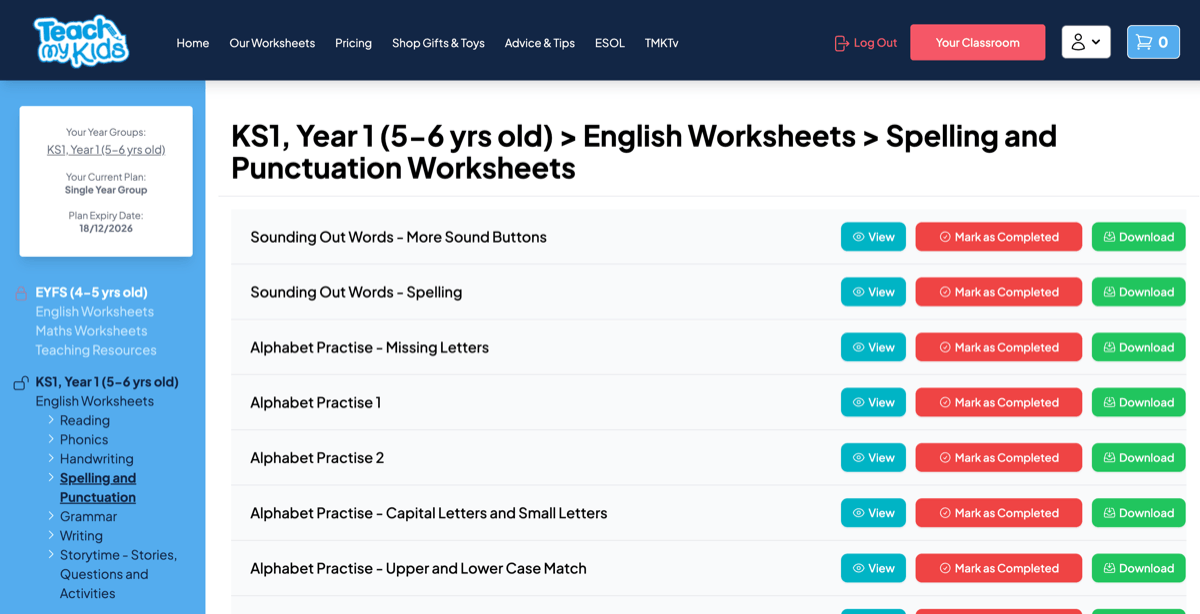
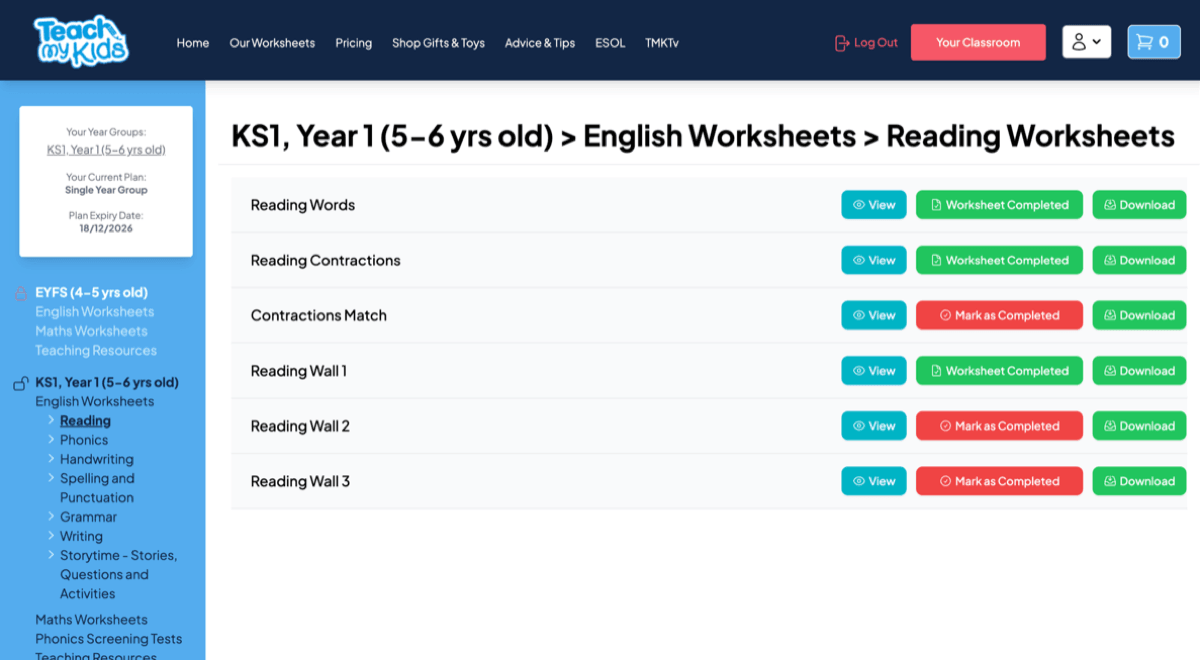
This is your child's online classroom.
You're not buying a single worksheet. You log in to a space set up for your child, where the full Year 3 library unlocks and everything stays in one place.
-
1.
Your own space, any time.
A login for your family. No app to install. Open it whenever suits you.
-
2.
Set to your child's year.
Pick their year group and the right worksheets unlock. Move it up as they grow.
-
3.
The whole library unlocks.
Every worksheet for their year in maths and English, matched to the school curriculum and sorted by topic. Not one sheet, all of them.
-
4.
Print what you need, when you need it.
The whole library is open, so you print this week's topics when they come up at school. No daily limit and nothing to ration. Come back as often as you like.
-
5.
Tick off what's done.
Mark each worksheet as done so you can see what your child has covered.
Common questions
Questions parents ask
- What is the difference between a verb and an adverb?
- A verb is the action or doing word, like run, think or jump. An adverb describes that verb and tells you how, when or where it happened, like quickly, yesterday or outside.
- How can I help my child with writing at home?
- Talk the idea through before they pick up a pencil. Planning out loud takes the pressure off the blank page. Keep the pieces short, praise one thing they did well, then let them read it back to you.
- What is a story mountain?
- A story mountain is a simple plan that splits a story into five parts: the opening, the build-up, the problem, the resolution and the ending. It helps a child see the shape of a story before they start writing.
From the kitchen table
From parents who already print at home.
Real parents, phonics through to SATs.
Putting Your Child's Education First


General
Worksheets by year and topic
- Reception maths worksheets
- Year 1 maths worksheets
- Year 2 maths worksheets
- Year 3 maths worksheets
- Year 4 maths worksheets
- Year 5 maths worksheets
- Year 6 maths worksheets
- Year 1 English worksheets
- Year 2 English worksheets
- Year 3 English worksheets
- Year 4 English worksheets
- Year 5 English worksheets
- Year 6 English worksheets
- Times tables worksheets
- Multiplication tables check
- Multiplication worksheets
- Division worksheets
- Fractions worksheets
- Decimals worksheets
- Percentages worksheets
- Place value worksheets
- Addition worksheets
- Subtraction worksheets
- Telling the time worksheets
- Shape worksheets
- Grammar worksheets
- Fronted adverbials
- Adverbs worksheets
- Nouns worksheets
- Verbs worksheets
- Adjectives worksheets
- Spelling worksheets
- Handwriting worksheets
- Phonics worksheets
- Phase 5 phonics
- KS2 SATs papers
- KS1 SATs papers
- Year 6 SATs
- Clauses
- Conjunctions
- Pronouns
- Determiners
- Modal verbs
- Apostrophes
- Punctuation worksheets
- Angles worksheets
- Symmetry worksheets
- Perimeter and area
- Rounding worksheets
- Roman numerals
- Negative numbers
- Money worksheets
- Sound buttons
- Tricky words
- Common exception words
- Browse all worksheets →
All rights reserved © Teach My Kids 2026. Site by BillyMedia, a Craft CMS developer