Why Sleep and Physical Activity is Important for Children - A Teacher's View
Maths and English worksheets for your child's year group, made by Sunita, an experienced UK primary school teacher. Print them at home and sit together for ten minutes.
Free trial, no card
Try the classroom free for 7 days
Sign up free, pick your child's year group and print 3 worksheets this week. Made by a UK primary school teacher, yours to use at the kitchen table.
- ✓Made by an experienced UK primary school teacher
- ✓Mapped to the national curriculum, Reception to Year 6
- ✓Print at home and work on paper, no screen needed
No card needed. One teacher, every worksheet.

Many schools are encouraging children to cycle or 'scooter' to school to encourage more physical activity in school children.
We like to feel like we are encouraging our children to take part in physical activity and think they are getting enough sleep, but how do we know we are doing enough? How does it affect children at school and does it have an impact on their education?
The best person to ask may be your child's teacher.
As a classroom teacher, I often had children coming up to me telling me about programmes they had watched the night before. Some of these programmes were on late at night (past 9pm). Some children's bedtime was so late, that it surprised me that I had gone to bed at a time earlier than the children had.
Many children said they went up to bed at 8pm but watched TV, DVD's' or played on their Playstation or Nintendo DS till late, often without their parents knowledge. A large majority of children also said that they would opt to play with handheld games consoles, rather than playing physical games.
Effects of not getting enough sleep and physical activity on children at primary school:
- less attentive, often daydreaming
- constant yawning and lethargy, possibly from waking up late and missing breakfast
- working at a very slow pace
- unwilling to answer questions or unable to understand what they are being asked to do
- less social due to being tired
- arriving at school late, thus missing valuable early morning teaching input
- distracting others and delaying the whole class routine, through late arrival
- forgetting PE kit, reading book, homework etc
- stressed and unhappy, having been shouted at by a parent or carer for waking up late
- decline in progress made at school
The impact on a child's education is huge, more than many parents realise. I could tell which children were not getting enough sleep, upon questioning the child, it always seemed to be the case.
What to do.
- Try and set a routine.
- Sleep - ensure your child to goes to bed and wakes up at the same time everyday on school days, if possible at the weekends too.
Games - try and give children a set amount of time on games consoles, encourage them to take part in other more physical activities. - Check to see what your child is doing once you have sent them to bed, have they gone to sleep or are they doing something else!
- Read a story to the at bedtime, it might help them 'wind down'.
- Does your child really need a TV, DVD player or games console in their room?
- Make sure your child has time for a good breakfast in the morning, it will help alleviate lethargy and tiredness at school.
- Get out at the weekends and go for walks or bike rides, you will all benefit form the extra exercise.
- Give children time out, if they have worked hard all and at school, they need time to do something they enjoy and exercise their creative mind.
Is your child getting enough sleep and physical activity?



Who makes the worksheets
Sunita
UK primary teacher
Every worksheet on Teach My Kids is made by Sunita, a UK primary school teacher with over ten years in the classroom. She writes each one by hand and maps it to the national curriculum, so what your child practises at home lines up with what they do at school. It's all on paper, not a screen, and takes about ten minutes a day.
Try the classroom freeWhat you're joining
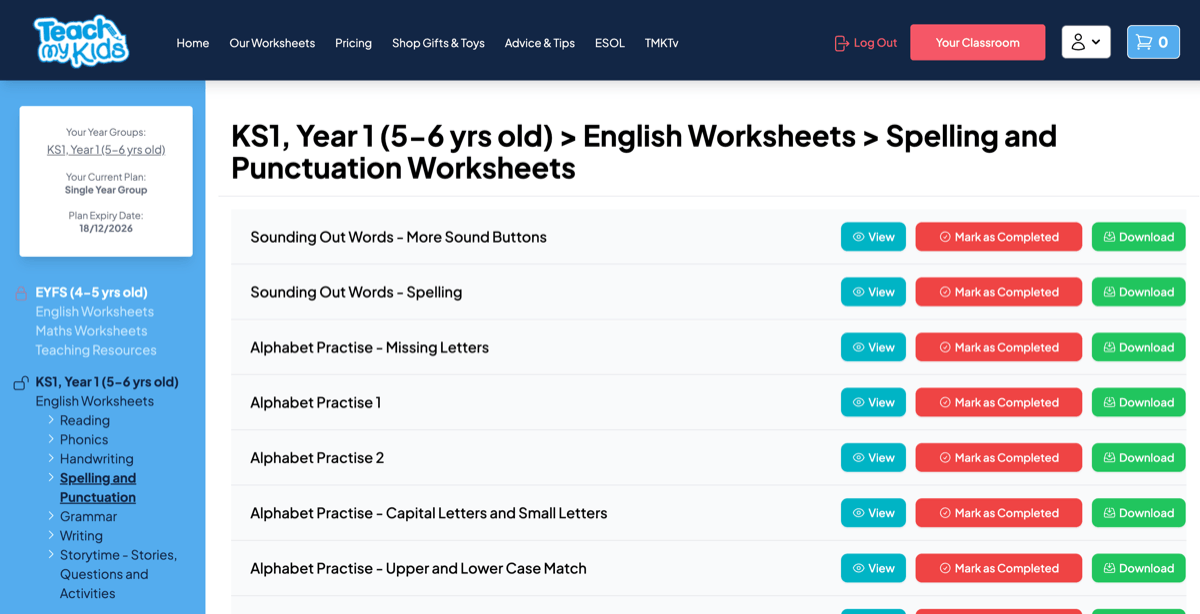
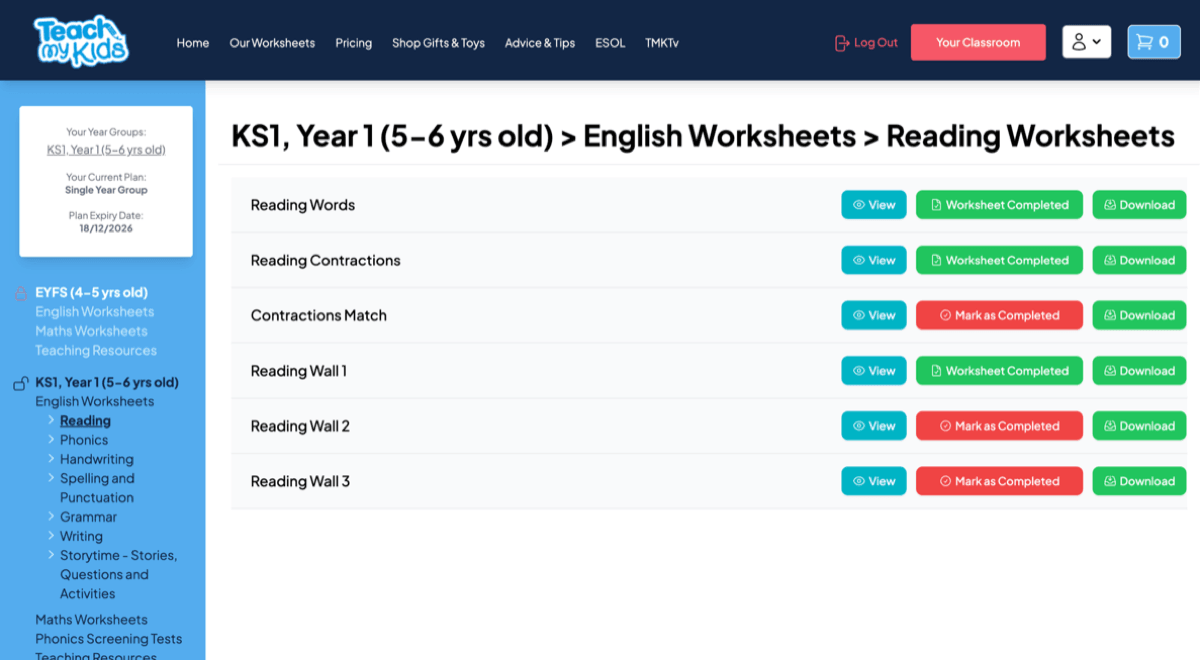
This is your child's online classroom.
You're not buying a single worksheet. You log in to a space set up for your child, where the full library unlocks and everything stays in one place.
-
1.
Your own space, any time.
A login for your family. No app to install. Open it whenever suits you.
-
2.
Set to your child's year.
Pick their year group and the right worksheets unlock. Move it up as they grow.
-
3.
The whole library unlocks.
Every worksheet for their year in maths and English, matched to the school curriculum and sorted by topic. Not one sheet, all of them.
-
4.
Print what you need, when you need it.
The whole library is open, so you print this week's topics when they come up at school. No daily limit and nothing to ration. Come back as often as you like.
-
5.
Tick off what's done.
Mark each worksheet as done so you can see what your child has covered.
Common questions
Questions parents ask
- Are the worksheets made by a teacher?
- Yes. Every worksheet is created by an experienced UK primary school teacher and mapped to the national curriculum, so what your child practises lines up with school.
- How does Teach My Kids work?
- Set your child's year group and the matching maths and English worksheets unlock. Print what you need at home, sit together for ten minutes, then tick off what they have finished.
- Can I print the worksheets at home?
- Yes. They are built for paper, so you print them at home and your child works away from a screen. That is the whole point: structured practice, off the device.
Year groups
Set your child's year and their library unlocks.
Every year is mapped to the UK curriculum. Pick the year your child is in and that whole library opens up. Move it up as they grow, or drop back a year if they need to catch up.
From the kitchen table
From parents who already print at home.
Real parents, phonics through to SATs.

Putting Your Child's Education First


General
Worksheets by year and topic
- Reception maths worksheets
- Year 1 maths worksheets
- Year 2 maths worksheets
- Year 3 maths worksheets
- Year 4 maths worksheets
- Year 5 maths worksheets
- Year 6 maths worksheets
- Year 1 English worksheets
- Year 2 English worksheets
- Year 3 English worksheets
- Year 4 English worksheets
- Year 5 English worksheets
- Year 6 English worksheets
- Times tables worksheets
- Multiplication tables check
- Multiplication worksheets
- Division worksheets
- Fractions worksheets
- Decimals worksheets
- Percentages worksheets
- Place value worksheets
- Addition worksheets
- Subtraction worksheets
- Telling the time worksheets
- Shape worksheets
- Grammar worksheets
- Fronted adverbials
- Adverbs worksheets
- Nouns worksheets
- Verbs worksheets
- Adjectives worksheets
- Spelling worksheets
- Handwriting worksheets
- Phonics worksheets
- Phase 5 phonics
- KS2 SATs papers
- KS1 SATs papers
- Year 6 SATs
- Clauses
- Conjunctions
- Pronouns
- Determiners
- Modal verbs
- Apostrophes
- Punctuation worksheets
- Angles worksheets
- Symmetry worksheets
- Perimeter and area
- Rounding worksheets
- Roman numerals
- Negative numbers
- Money worksheets
- Sound buttons
- Tricky words
- Common exception words
- Browse all worksheets →
All rights reserved © Teach My Kids 2026. Site by BillyMedia, a Craft CMS developer