Spelling Tips: How to Help a Child Learn Their Spellings
Maths and English worksheets for your child's year group, made by Sunita, an experienced UK primary school teacher. Print them at home and sit together for ten minutes.
Free trial, no card
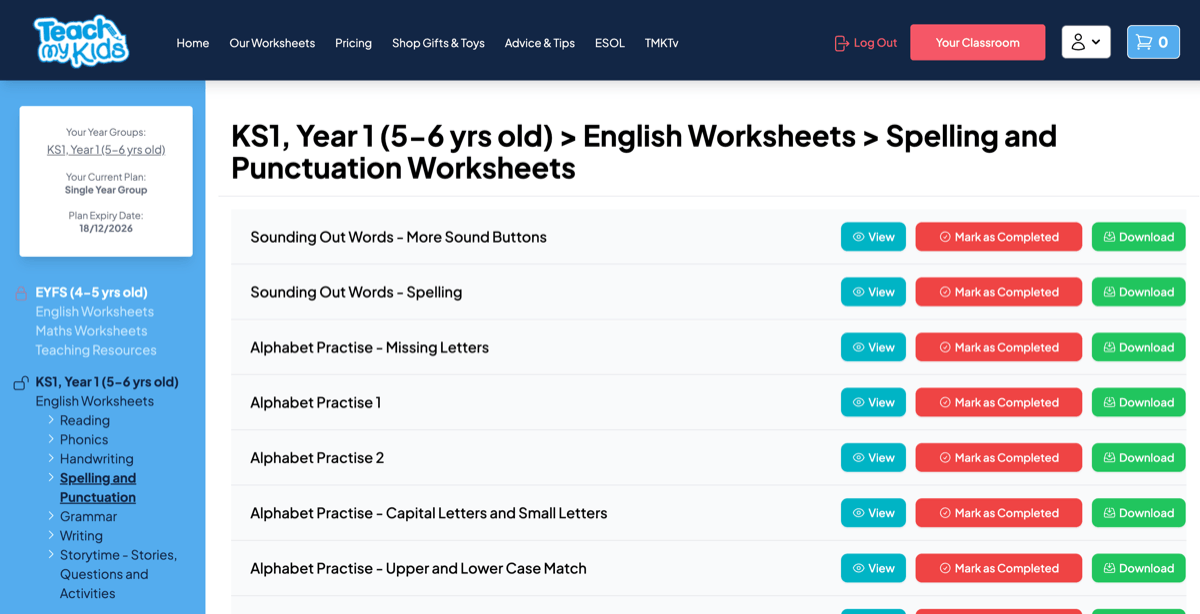
Spelling practice for Year 2, ready to print
Sign up free, pick your child's year group and print 3 worksheets this week. Made by a UK primary school teacher, yours to use at the kitchen table.
- ✓Made by an experienced UK primary school teacher
- ✓Mapped to the national curriculum, Reception to Year 6
- ✓Print at home and work on paper, no screen needed
No card needed. One teacher, every worksheet.
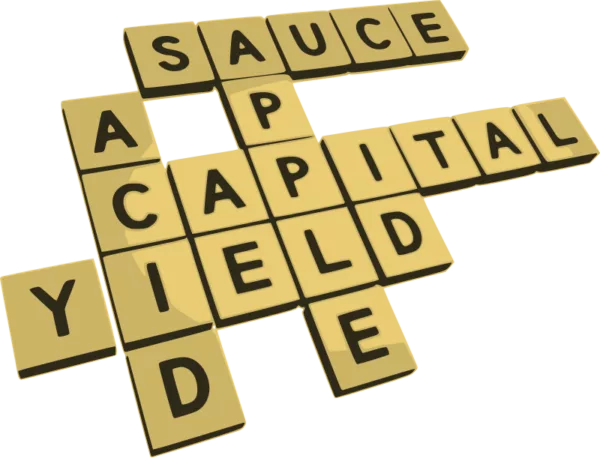
How to Learn Spellings.
Spelling tips and Strategies for Children
Your child may be given a set of words to learn each week and then tested on their ability to spell them.
The National Curriculum has set out spelling rules, common letters strings, prefixes, suffixes, keywords etc that children must know by the end of certain year groups. It is important to keep on top of the suggestions made by the Primary National Curriculum to make sure children make progress and are using the new words learnt to improve their vocabulary and writing.
How to Improve Children's Spelling, Teaching Children New Vocabulary
- How do you help your child learn to spell new words?
- How do you get them to remember the spelling, use it in their writing and remember what the word means?
There are many ways to help children improve their spelling. The key is to not only help them learn strategies to remember the spelling, but to also use the word in a sentence. Learning to read and learning to spell words go hand in hand.
Reading both fiction and non-fiction texts on a regular basis is essential. Reading helps reinforce the spelling of words without the child even realising. It is one of the best ways to help your child learn new vocabulary. Reading allows children to come across words they wouldn't usually hear or use. Children will often try and figure out what the new vocabulary means by reading around the word or guessing what the word means. They may also try and use the new words they have learnt from reading in their writing. The more often a child uses a new word in their writing, the more likely they are to learn to spell the word and remember how to spell it.
How to Teach Spelling in a Fun Way
Children can learn to spell words in different ways:
- by sounding out the word
- breaking the word up into syllables
- learning to spell the word by sight
Your child might learn their spellings better ad quicker if it is turned in a game. Teaching your child to spell in a fun way will encourage them to learn the words and remember them.
Here are some quick fun games you can play to teach your child to spell:
- Using spelling flashcards.
- Write the words your child needs to learn onto cards.
Each word will be need to be written out twice i.e. 2 cards for each word. Mix the cards and place them face down on a table. Take it in turns to turns to cards over. Read the words on the cards. If they match, you keep them, if they don't match turn them face down again. The person with the most pairs of words is the winner.
- Learn spellings by clapping them.
You can clap each syllable e.g. app - le, break - fast, diff - er - ence
- Play hangman using the words your child needs to learn.
Alternatively, you could put rules into place e.g. the words used for hangman have to be an adjective or words that end in '-ible'
- Ask your child to create a word search using the spelling words they need to learn.
- Turn the words your child needs to learn into an anagram, can they rearrange the letters to spell the words e.g. rednfi = friend
Join Teach My Kids to gain access to Spelling worksheets for Kids. Plus a wide range of worksheets covering Math and English.
How Do You Remember Spelling Words?
Look, Say, Cover, Write, Check
This is a method commonly use to help children learn and remember how to spell words.
Look: Look at how the word is spelt. |
Say: Look at the word and say it. Break the word into smaller chunks, e.g. ‘she’ to sh / e |
Cover: Look at the word and say it. Cover the word, try and see it in your mind. |
Write: Look at the word, say it, cover it and say it. Write the word without looking |
Check: Cover the word and see if you can write it. |
Spelling Tests at School - How to Help Your Child Memorise Spelling Words
You can test your child on the spellings they have learnt.
You can check to see if your child understands the meaning of a word by asking them to say a sentence using the word, or by writing a sentence.
Child Struggling with Spelling?
Join Teach My Kids
Get access to targeted worksheets for you child's year group in Maths and English.
Use Teach My Kids literacy worksheets to improve your child's writing and spelling. Give your kids a helping hand today.
You might also like to read:
Learning Consonant-Vowel-Consonant Phonics
6 Ways To Encourage 4-8 Year Olds To Retell A Story (Speaking & Writing)
5 Ways To Help Your Child With SATS Revision
How To Improve Your Childs Creative Writing
Free English Worksheets:
Free Worksheet - Writing Stories, Story Mountain
Take a look at our Spelling Packs
Created to help children learn spellings appropriate for their age.
Join Teach My Kids to gain access to Spelling worksheets for Kids.



Who makes the worksheets
Sunita
UK primary teacher
Every worksheet on Teach My Kids is made by Sunita, a UK primary school teacher with over ten years in the classroom. She writes each one by hand and maps it to the national curriculum, so what your child practises at home lines up with what they do at school. It's all on paper, not a screen, and takes about ten minutes a day.
Try the classroom freeWhat you're joining
This is your child's online classroom.
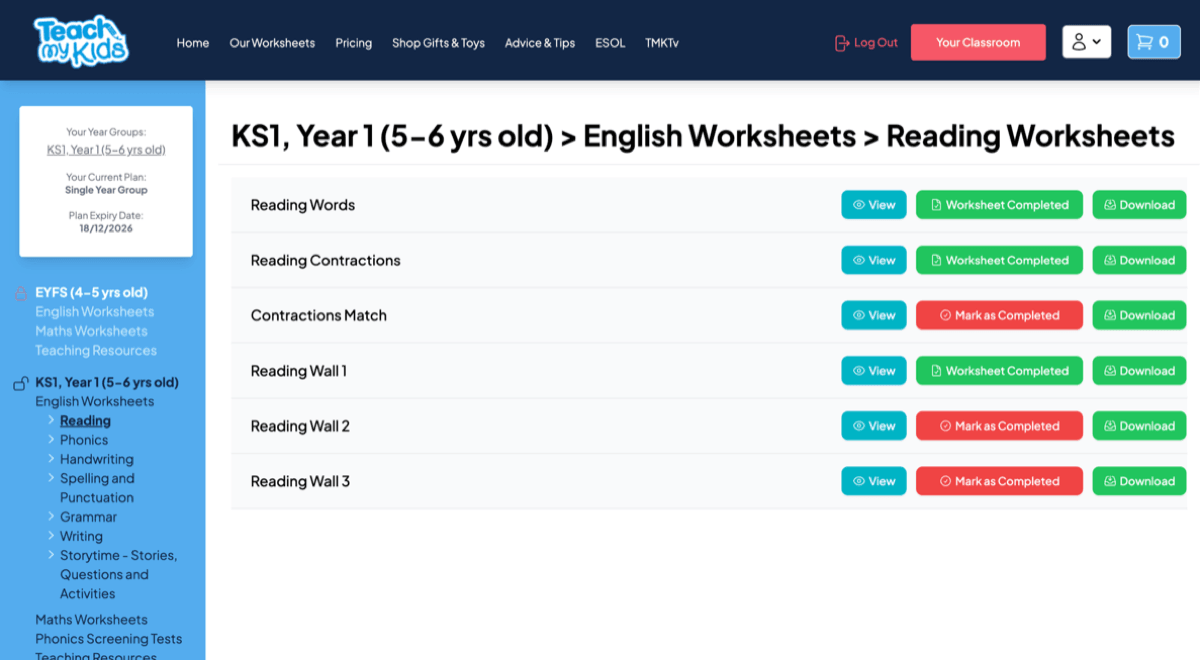
You're not buying a single worksheet. You log in to a space set up for your child, where the full Year 2 library unlocks and everything stays in one place.
-
1.
Your own space, any time.
A login for your family. No app to install. Open it whenever suits you.
-
2.
Set to your child's year.
Pick their year group and the right worksheets unlock. Move it up as they grow.
-
3.
The whole library unlocks.
Every worksheet for their year in maths and English, matched to the school curriculum and sorted by topic. Not one sheet, all of them.
-
4.
Print what you need, when you need it.
The whole library is open, so you print this week's topics when they come up at school. No daily limit and nothing to ration. Come back as often as you like.
-
5.
Tick off what's done.
Mark each worksheet as done so you can see what your child has covered.
Common questions
Questions parents ask
- How can I help my child with spelling at home?
- Keep it short and regular. Five or ten minutes a day beats one long session a week. Pick a few words your child finds tricky, practise them with look, say, cover, write, check, then come back to them later in the week.
- Why does my child struggle with spelling?
- Spelling asks a child to juggle sound, pattern and memory at once, so it often lags behind reading. Most get there with regular practice and a bit of patience. Look at the patterns behind the words, not just the words on their own.
- What is the best way to learn spellings?
- Little and often, tied to words your child already knows. Look, say, cover, write, check works well, and so does spotting the same pattern in other words. Reading together helps too, because it puts the spellings in real sentences.
From the kitchen table
From parents who already print at home.
Real parents, phonics through to SATs.
Putting Your Child's Education First


General
Worksheets by year and topic
- Reception maths worksheets
- Year 1 maths worksheets
- Year 2 maths worksheets
- Year 3 maths worksheets
- Year 4 maths worksheets
- Year 5 maths worksheets
- Year 6 maths worksheets
- Year 1 English worksheets
- Year 2 English worksheets
- Year 3 English worksheets
- Year 4 English worksheets
- Year 5 English worksheets
- Year 6 English worksheets
- Times tables worksheets
- Multiplication tables check
- Multiplication worksheets
- Division worksheets
- Fractions worksheets
- Decimals worksheets
- Percentages worksheets
- Place value worksheets
- Addition worksheets
- Subtraction worksheets
- Telling the time worksheets
- Shape worksheets
- Grammar worksheets
- Fronted adverbials
- Adverbs worksheets
- Nouns worksheets
- Verbs worksheets
- Adjectives worksheets
- Spelling worksheets
- Handwriting worksheets
- Phonics worksheets
- Phase 5 phonics
- KS2 SATs papers
- KS1 SATs papers
- Year 6 SATs
- Clauses
- Conjunctions
- Pronouns
- Determiners
- Modal verbs
- Apostrophes
- Punctuation worksheets
- Angles worksheets
- Symmetry worksheets
- Perimeter and area
- Rounding worksheets
- Roman numerals
- Negative numbers
- Money worksheets
- Sound buttons
- Tricky words
- Common exception words
- Browse all worksheets →
All rights reserved © Teach My Kids 2026. Site by BillyMedia, a Craft CMS developer