How To Improve your Child's Creative Writing In Literacy
Maths and English worksheets for your child's year group, made by Sunita, an experienced UK primary school teacher. Print them at home and sit together for ten minutes.
Free trial, no card
Every grammar and writing worksheet for Year 3, in one place
Sign up free, pick your child's year group and print 3 worksheets this week. Made by a UK primary school teacher, yours to use at the kitchen table.
- ✓Made by an experienced UK primary school teacher
- ✓Mapped to the national curriculum, Reception to Year 6
- ✓Print at home and work on paper, no screen needed
No card needed. One teacher, every worksheet.

Writing In School
Children in Primary School are asked regularly to write stories, poems, plays, newspaper reports, letters, explanations...
One area many children struggle with is writing for these different text types, in a way that will be interesting for the reader. Creative writing often involves a child writing detailed descriptions and the ability to place themselves in the position of the character or person they are writing about or writing to.
But how can you help a child get better at this? Especially when every time you ask them to write, they only use basic, simple sentences, that offer very little detail or is very bland and boring.
How do you encourage a child to use a variety of describing words, and words that are chosen for variety, interest and effect?
6 great ways to help improve children's creative writing skills (KS1 and KS2).
- Give children the opportunity to write about things they know about.
Before any writing even begins you could talk about books you have read together, things or events.
You could start with picture prompts:
For example:
You can use picture books, magazines or even nature photos as inspiration. Ask children, 'What might happen next in this scene?'
Here are some recommend books you can read with your child:
Reading Books for 3-5 Year Olds
Reading Books for 5-7 Year Olds
Reading Books for 7-9 Year Olds
Reading Books for 9-11 Year Olds
Books by Well Known Authors
Julia Donaldson
Roald Dahl
David Walliams - Children find it easier to write about things they know about.
Asking children to write about things within their experience will allow them to think more about how and what they are writing, rather than also trying to make up information they know nothing about.
Give children writing tasks that involve things they know about, have seen and experienced. It is difficult to ask a child to write a story or create an information leaflet about the seaside, if they have never been to one! - Give children plenty of first hand experiences.
Do things with children like:
Visiting a farm
Going to buy fruit from the market
Washing the car
Going to the seaside
Going a bus or train Act out experiences or situations (role play).
You can encourage children to do this by themselves, with siblings, friends or with an adult.
Ideas for role play can include:
Playing shopkeeper and customer Buy Shopkeeper Role Play Items
Dressing up as characters from a story Buy Story Dressing Up
Acting out all or part of a short / traditional story Buy Traditional Stories
Being in a restaurant where one person is the chef/waiter and the other a customer
Making a den or cave using cushions and blankets Buy A Den Making Kit- Become one of the characters from a story.
One person can be the main character from a story (e.g. Cinderella), they other person can then interview or ask questions based on the story or characters personality or events from the story. Encourage your child to put themselves in the characters place.
Ask questions like:
Why did you...,
Who is....,
How did you....,
What was....,
Where....,
When.... - Let children use all of their senses (sight, smell, sound, touch, taste).
Encourage your child to use their five senses to describe things.
Activities to encourage describing could include:
Making a fruit salad (describe the different fruits whilst making and eating it),
Go into your garden in the morning and then at night - how is it different,
Squash bananas or other food with your hands.
Join Teach My Kids today to improve your child's Maths and English Skills.
Overcoming Some Common Barriers When Children Are Asked To Write
- What if a child says, 'I hate writing!'
Start small. Don’t push for full stories.
Encourage them to write lists, notes or even silly jokes. Gradually, their confidence will grow.
You could model write part of a story together, where you take it in turns to write a sentence each, or write a sentence or two, then let your child continue. It’s a great way to build momentum. - What if they get stuck?
Ask open-ended questions like, 'What happens next?' or 'How does your character solve the problem? This will help children gather their thoughts or come up with ideas. - Don't know what to talk about?
It can be hard to find things to talk about with your child sometimes. It's always best to talk about something they are interested in,
This could be about:
Their favourite toy
Their favourite game
Favourite foods
Favourite TV Programmes Find Appropriate TV Programmes on Amazon Kids
A book they might enjoy reading repeatedly
A walk to school or nursery
You Might Also Like To Read:
How To Write More Interesting Sentences
Help Your Child Improve Their Reading
How To Get Your Child To Finish Their Homework
Free Worksheet - Story Ideas Helpsheet
Free Worksheet - Story Writing Plan, Story Mountain
Free Worksheet - Writing Descriptive Sentences
Free Worksheet - Making Sentences More Interesting
Want a workbook to help improve your child's writing skills in Fiction and Non-fiction writing?
Visit our TMKed shop to Purchase Literacy Workbooks for Kids
Join Teach My Kids to gain access to a whole year's worth of Maths and English worksheets.



Who makes the worksheets
Sunita
UK primary teacher
Every worksheet on Teach My Kids is made by Sunita, a UK primary school teacher with over ten years in the classroom. She writes each one by hand and maps it to the national curriculum, so what your child practises at home lines up with what they do at school. It's all on paper, not a screen, and takes about ten minutes a day.
Try the classroom freeWhat you're joining
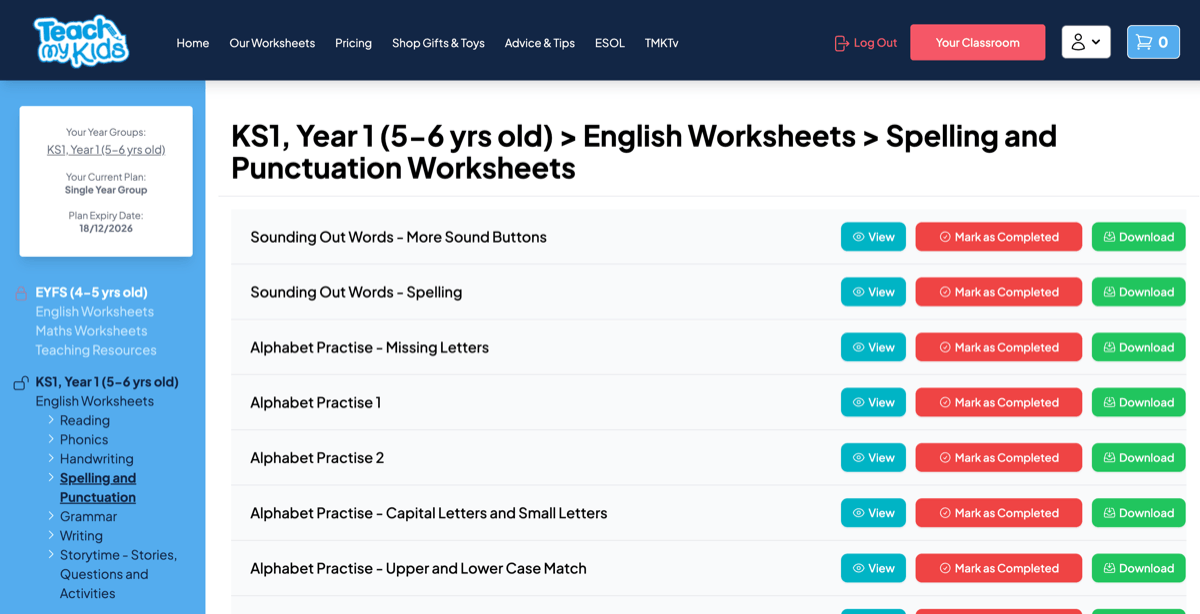
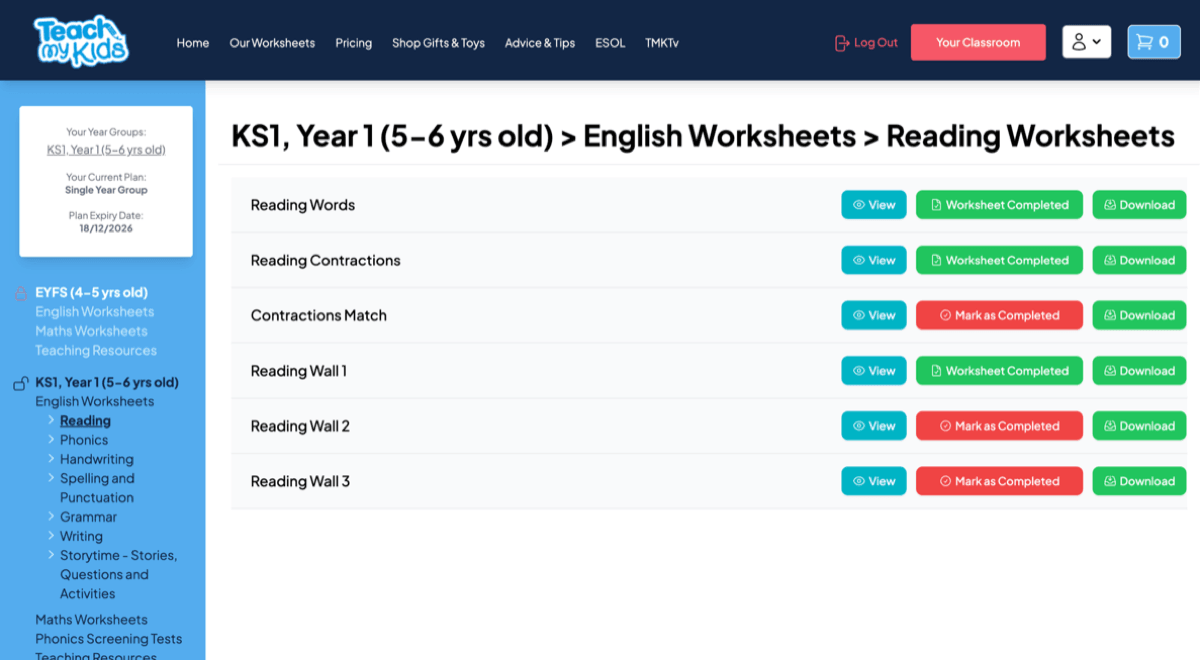
This is your child's online classroom.
You're not buying a single worksheet. You log in to a space set up for your child, where the full Year 3 library unlocks and everything stays in one place.
-
1.
Your own space, any time.
A login for your family. No app to install. Open it whenever suits you.
-
2.
Set to your child's year.
Pick their year group and the right worksheets unlock. Move it up as they grow.
-
3.
The whole library unlocks.
Every worksheet for their year in maths and English, matched to the school curriculum and sorted by topic. Not one sheet, all of them.
-
4.
Print what you need, when you need it.
The whole library is open, so you print this week's topics when they come up at school. No daily limit and nothing to ration. Come back as often as you like.
-
5.
Tick off what's done.
Mark each worksheet as done so you can see what your child has covered.
Common questions
Questions parents ask
- What is the difference between a verb and an adverb?
- A verb is the action or doing word, like run, think or jump. An adverb describes that verb and tells you how, when or where it happened, like quickly, yesterday or outside.
- How can I help my child with writing at home?
- Talk the idea through before they pick up a pencil. Planning out loud takes the pressure off the blank page. Keep the pieces short, praise one thing they did well, then let them read it back to you.
- What is a story mountain?
- A story mountain is a simple plan that splits a story into five parts: the opening, the build-up, the problem, the resolution and the ending. It helps a child see the shape of a story before they start writing.
From the kitchen table
From parents who already print at home.
Real parents, phonics through to SATs.
Putting Your Child's Education First


General
Worksheets by year and topic
- Reception maths worksheets
- Year 1 maths worksheets
- Year 2 maths worksheets
- Year 3 maths worksheets
- Year 4 maths worksheets
- Year 5 maths worksheets
- Year 6 maths worksheets
- Year 1 English worksheets
- Year 2 English worksheets
- Year 3 English worksheets
- Year 4 English worksheets
- Year 5 English worksheets
- Year 6 English worksheets
- Times tables worksheets
- Multiplication tables check
- Multiplication worksheets
- Division worksheets
- Fractions worksheets
- Decimals worksheets
- Percentages worksheets
- Place value worksheets
- Addition worksheets
- Subtraction worksheets
- Telling the time worksheets
- Shape worksheets
- Grammar worksheets
- Fronted adverbials
- Adverbs worksheets
- Nouns worksheets
- Verbs worksheets
- Adjectives worksheets
- Spelling worksheets
- Handwriting worksheets
- Phonics worksheets
- Phase 5 phonics
- KS2 SATs papers
- KS1 SATs papers
- Year 6 SATs
- Clauses
- Conjunctions
- Pronouns
- Determiners
- Modal verbs
- Apostrophes
- Punctuation worksheets
- Angles worksheets
- Symmetry worksheets
- Perimeter and area
- Rounding worksheets
- Roman numerals
- Negative numbers
- Money worksheets
- Sound buttons
- Tricky words
- Common exception words
- Browse all worksheets →
All rights reserved © Teach My Kids 2026. Site by BillyMedia, a Craft CMS developer